

Summary & Insights
Can a business idea be too normal? The prevailing theory discussed here is that if every person in a room nods in agreement when you pitch a startup, you should run away—because you’re likely about to waste three years on a commodity. To truly succeed, an idea needs to be “good crazy,” meaning it sounds absurd or counterintuitive at first, similar to the early days of Airbnb or Uber, where the idea of letting strangers sleep on your couch or drive you home seemed like a recipe for disaster.
The conversation meanders through a series of these “crazy” ventures, ranging from AI-powered dog collars that claim to translate barks to “Superbrain,” a device that allows users to chat with AI versions of deceased loved ones. While some ideas are dismissed as “bad crazy” or “amazing stupid,” others are hailed as brilliant marketing. For instance, the hosts analyze a viral strategy where OnlyFans creators purchased strategic NBA seating directly behind the coach to ensure constant television exposure—a move described as the modern-day equivalent of naming your business “AAA Locksmith” to top the yellow pages.
A significant portion of the dialogue focuses on the “return to the real” and the fight against digital addiction. This “anti-tech” trend is manifesting in products like “dumb phones” that forward calls to a basic device to limit screen time, physical landlines designed for a modern audience, and “phone jails.” The central thesis is that as the world becomes more overstimulated, there is a massive, growing market for “state management”—using physical experiences like high-end saunas, breathwork, and tactile gadgets to forcibly shift a person’s mental and emotional state.
Surprising Insights
- The “NQR” Concept: A term used in China meaning “Not Quite Right,” describing products that are almost exact replicas of Western brands but feel slightly off in execution.
- Prediction Markets for Science: Some startups are using betting markets to predict the success of biotech clinical trials, theorizing that “skin in the game” produces more accurate probabilities than individual expert opinions.
- State Management: The idea that the body can “drag the mind,” meaning that physical inputs (extreme heat, cold, specific scents) are more effective at changing a person’s mood than trying to “think” oneself into a better state.
- The “Kidulting” Economy: There is a multi-billion dollar industry dedicated to providing adults with childhood-like experiences (e.g., complex Lego sets or game-only newspapers) as a primary method of stress relief.
Practical Takeaways
- Test Your Business Ideas: If your idea is universally praised as “safe” or “logical,” pivot toward something that provokes a “who would actually do that?” reaction to find a more unique market edge.
- Leverage “Anti-Trends”: Identify a common modern frustration (like smartphone addiction) and build a “simplified” or “physical” alternative that serves as a “nicotine patch” for that addiction.
- Focus on Brand as a Moat: In a world of rapid AI duplication, the technical product is rarely the moat; the visual identity, storytelling, and emotional connection of the brand are what prevent competitors from stealing your customers.
- Use Physicality to Reset: To break a mental rut or a “doom scrolling” cycle, use a physical disruptor—like a timed lockbox for your phone or a high-intensity sensory experience—to force a change in your mental state.
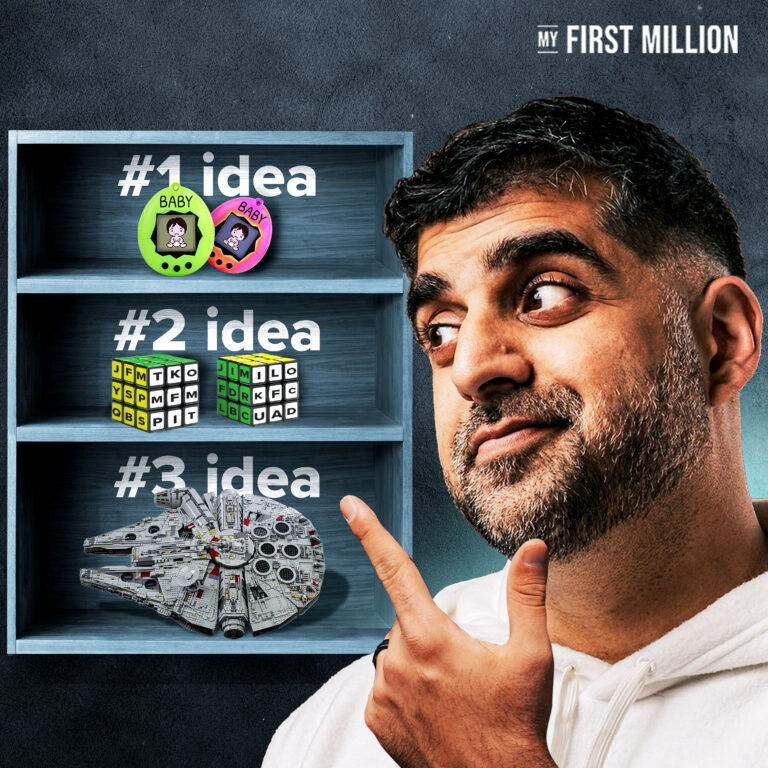
Episode 545: Shaan Puri (https://twitter.com/ShaanVP) and Sam Parr (https://twitter.com/theSamParr) brainstorm $100M retro business ideas: LEGO for adults, Tamagotchis for millennials & MORE.
No more small boy spreadsheets, build your business on the free HubSpot CRM: https://mfmpod.link/hrd
—
Show Notes:
(0:00) Intro
(2:30) Sam auditions a 7,500 sf house
(5:00) LEGO for adults
(13:00) Kidult market trends
(20:00) Tamigachi babies for millennials
(21:30) K’nex 2.0
(23:30) Easier Rubik’s cube
(25:30) Candle pouring kits
(29:00) The rabid community behind Rebrickable
(35:30) The fascinating legacy of BrickLink
(46:00) Grow like Fanfiction
(51:00) Build the reverse funnel
(58:00) Palworld’s $200M week
(1:03:00) Midwit strikes again
—
Links:
• Calm – http://calm.com/
• Rebrickable – http://tinyurl.com/4tt7974b
• BrickLink – http://tinyurl.com/yjzhja28
• Kim Jung-ju – https://en.wikipedia.org/wiki/Kim_Jung-ju
• Wattpad – https://www.wattpad.com/
• Palworld on Steam – http://tinyurl.com/2tus5wfz
—
Check Out Sam’s Stuff:
• Hampton – https://www.joinhampton.com/
• Ideation Bootcamp – https://www.ideationbootcamp.co/
• Copy That – https://copythat.com
• Hampton Wealth Survey – https://joinhampton.com/wealth
Check Out Shaan’s Stuff:
• Try Shepherd Out – https://www.supportshepherd.com/
• Shaan’s Personal Assistant System – http://shaanpuri.com/remoteassistant
• Power Writing Course – https://maven.com/generalist/writing
• Small Boy Newsletter – https://smallboy.co/
• Daily Newsletter – https://www.shaanpuri.com/

Leave a Reply
You must be logged in to post a comment.