

0
0
Summary & Insights

What happens to the AI landscape if GPUs suddenly dropped in price by 99%? This provocative question sets the stage for a deep dive into the infrastructure and economics of open-weight AI models. The conversation centers on the shift from “enthusiast” open-source projects to critical industrial infrastructure, exemplified by VLLM. As an inference engine, VLLM acts as the essential bridge between raw hardware (GPUs/TPUs) and the intelligence endpoints that power modern applications, effectively serving as the “operating system” for the AGI economy.

The dialogue highlights a growing tension between closed-source proprietary APIs and open-weight models. While companies like OpenAI and Anthropic currently lead in general usage, a threshold was crossed roughly a year ago where high-growth startups began migrating toward open-weight models to avoid being mere “wrappers.” The drivers for this shift are twofold: cost and control. For high-stakes use cases—such as voice agents requiring strict latency SLAs or developers needing to bypass arbitrary and often “false positive” corporate guardrails—owning the weights and the infrastructure is the only way to ensure reliability and security.

The economic model of AI is also evolving, moving away from the traditional “donation-based” open-source software model toward something resembling the pharmaceutical industry. Because training frontier models requires millions of dollars in compute rather than just volunteer hours, new licensing terms are emerging to ensure sustainability. Despite these costs, the gap between open-weight and proprietary models is closing rapidly. The focus is shifting from mere data collection to the creation of sophisticated “environments” where models can iteratively improve, suggesting that the future of AI will be defined by algorithmic innovation and recursive self-improvement rather than just the size of a closed dataset.

Surprising Insights

  • The “Guardrail” Migration: Users are increasingly retreating from top-tier proprietary models not because of capability, but because overly aggressive safety filters (false positives) are actively blocking legitimate technical work, such as studying GPU kernels.
  • Hardware as a Benchmark: Hardware giants like NVIDIA, AMD, and Google now use VLLM as a benchmark to ensure their newest chips are optimized for the way the world actually runs AI models.
  • The Death of RoPE: In a poetic turn of technical iteration, the original inventor of Rotary Positional Embedding (RoPE) recently helped remove it from the Kimi K3 model, proving that “simpler is better” as the field matures.
  • Distillation Overstated: Contrary to popular belief, the rapid progress of open-weight models is driven more by the construction of specialized training environments than by “distilling” knowledge from larger, closed models.

Practical Takeaways

  • Prioritize Control for SLAs: If your application requires a strict Service Level Agreement (SLA)—especially for real-time voice or high-speed agents—deploy open-weight models on your own infrastructure to avoid the unpredictability of proprietary APIs.
  • Leverage “Day Zero” Support: When adopting new models, utilize inference engines like VLLM that offer day-zero support to ensure you can move from a research prototype to production without waiting for official vendor updates.
  • Optimize for Speed Tiers: Instead of relying on a simple “fast vs. slow” toggle provided by API vendors, use open-weight deployments to calibrate specific speed levels (e.g., aiming for 400-500 tokens per second) to match the exact needs of your end-user experience.
  • Evaluate via “Environments,” Not Just Benchmarks: When choosing a model for specialized tasks like coding, look at the training environment the lab used (e.g., how the model iterates on rendered code) rather than just a static leaderboard score.

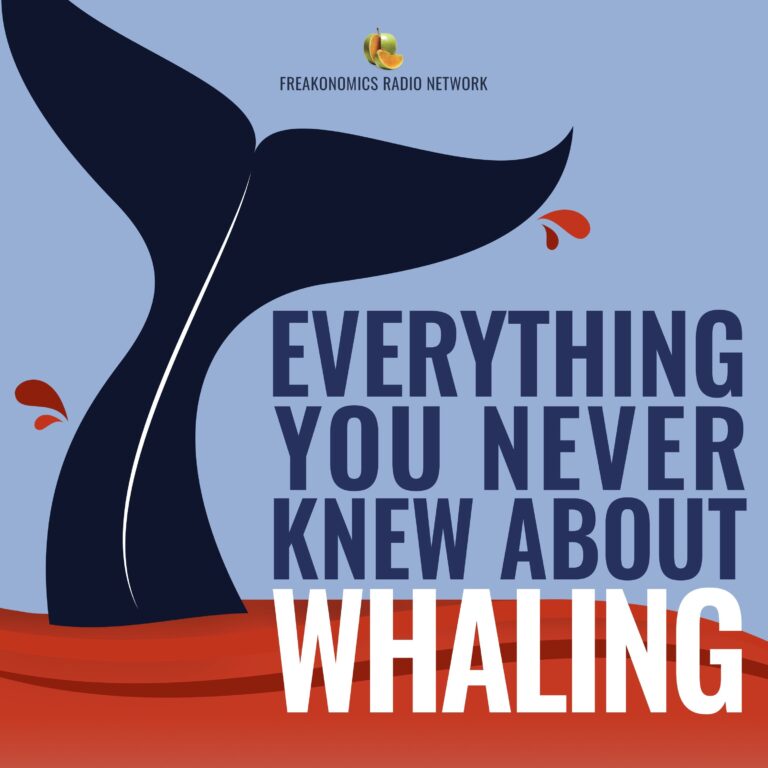
Whaling was, in the words of one scholar, “early capitalism unleashed on the high seas.” How did the U.S. come to dominate the whale market? Why did whale hunting die out here — and continue to grow elsewhere? And is that whale vomit in your perfume? (Part 1 of “Everything You Never Knew About Whaling.”)


  • SOURCES:


Hosted by Simplecast, an AdsWizz company. See pcm.adswizz.com for information about our collection and use of personal data for advertising.

Freakonomics RadioFreakonomics Radio
Let's Evolve Together
Logo