
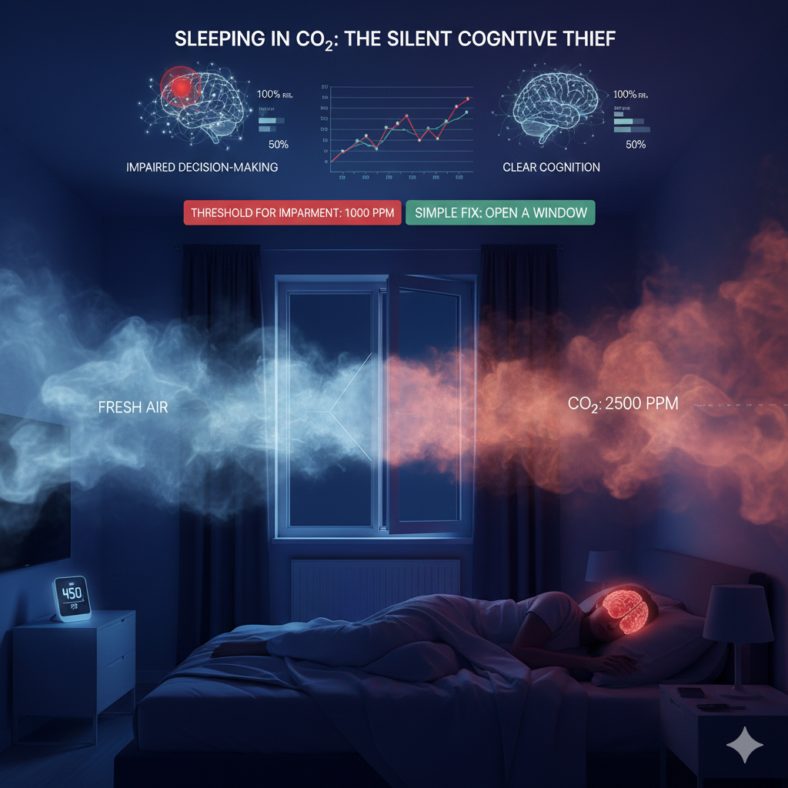
You’ve invested in a good mattress, blackout curtains, and maybe even a white noise machine. You go to bed at a reasonable hour, avoid screens before bedtime, and stick to a consistent sleep schedule. Yet you still wake up feeling foggy, struggle to make decisions in the morning, and can’t seem to shake that mental sluggishness until after your second cup of coffee.
What if the problem isn’t your sleep hygiene at all? What if you’re slowly suffocating your brain every single night?
The Silent Cognitive Thief in Your Bedroom
Here’s something most people don’t realize: while you sleep, you’re exhaling carbon dioxide (CO₂) with every breath. In a poorly ventilated room, that CO₂ accumulates, creating an invisible cloud that quietly impairs your brain function. And the threshold for impairment is surprisingly low.
Research published in Environmental Health Perspectives found that CO₂ levels above 1,000 parts per million (ppm) significantly decrease decision-making abilities. At 2,500 ppm, the cognitive decline becomes even more dramatic. A comprehensive review in Environmental International confirmed that cognitive functions like decision-making and problem-solving start deteriorating at approximately 1,000 ppm.
To put this in perspective, outdoor air typically contains around 400-425 ppm of CO₂. A closed bedroom with one or two people sleeping can easily reach 1,000-2,500 ppm by morning. You might think you’re getting eight hours of rest, but your brain is actually marinating in a cognitive suppressant all night long.
Studies on school environments show the real-world impact: when indoor CO₂ levels reach around 1,500 ppm (only triple outdoor levels), certain cognitive test scores can drop by 50%. We spend 90% of our time indoors, yet most of us have no idea what we’re breathing.
Why You Feel Terrible After Flying
Ever noticed how airplane travel leaves you feeling inexplicably exhausted, even on relatively short flights? Sure, there’s jet lag if you cross time zones, and the stress of travel itself. But there’s another culprit: recirculated air with elevated CO₂ levels.
Breathing expert James Nestor has been carrying a CO₂ monitor with him for years, documenting air quality everywhere he goes. His findings about air travel are striking: “The average CO₂, when you are entering onto an airplane and all suddenly everyone just starts falling asleep, they’re not tired. It’s because the CO₂ levels are around 2,500 parts per million.” He adds: “I have not recorded one flight anywhere on planet Earth where it hasn’t been over 1,000 parts per million. Every single flight is.”
To put this in perspective, outdoor air contains around 425 ppm of CO₂. Engineering associations recommend indoor levels should never exceed 1,000 ppm, as that’s when environments start to feel stuffy and cognitive performance begins to decline. At 2,500 ppm (the level Nestor consistently finds on airplanes), studies show cognitive test scores can drop by as much as 50%, and people experience headaches and further mental impairment.
While modern aircraft do have ventilation systems that refresh cabin air 20-30 times per hour and HEPA filters that remove 99.97% of particulate material, these systems don’t address CO₂ accumulation. That post-flight brain fog isn’t just in your head; it’s literally caused by what’s been building up in your head during the flight.
The Simplest Solution You’re Probably Ignoring
Here’s the good news: fixing this problem costs nothing and requires minimal effort. Open a window. Even just a crack.
That’s it.
By allowing fresh air to circulate through your bedroom, you prevent CO₂ buildup and maintain levels closer to outdoor concentrations. This simple action can dramatically improve both your sleep quality and next-day cognitive performance. Studies have shown that people sleeping in well-ventilated rooms demonstrate better logical thinking and problem-solving abilities the following day compared to those in poorly ventilated spaces.
“But won’t I be cold?” you might ask. Actually, that’s a bonus. Cooler bedroom temperatures (around 60-67°F or 15-19°C) are associated with better sleep quality. Your body temperature naturally drops during sleep, and a cooler room facilitates this process. Opening a window addresses two sleep-optimization factors simultaneously: it reduces CO₂ accumulation AND helps maintain an ideal sleep temperature.
Beyond the Bedroom
The implications extend beyond your nightly rest. If you work in an office with poor ventilation, you might be functioning at reduced cognitive capacity throughout the day. Conference rooms, classrooms, and other enclosed spaces where people gather can quickly develop elevated CO₂ levels, affecting everyone’s ability to think clearly and make sound decisions.
James Nestor’s research reveals a troubling trend in modern hotels: “In the past 10 years, something very curious has happened. Every hotel used to be able to open the window… Now they’re all glued up.” Why? Because heating and cooling accounts for about 50% of maintenance costs, so hotels recirculate air instead of pumping in fresh air. The irony? The most expensive hotels with LEED and GREEN certifications often have the worst air quality. Nestor recorded CO₂ levels as high as 2,800 ppm when waking up in a “green certified” hotel.
His solution: “Have yourself or your assistant call ahead and ask a hotel, do you have windows? Well, sir, of course we have windows. Can you open those windows just a little bit, just a little bit? And those are the hotels you stay at.”
Consider using a CO₂ monitor in your bedroom and workspace. Nestor recommends the Aranet 4, which he tested against professional devices and found to be the most accurate consumer option. Most experts recommend keeping indoor CO₂ levels below 1,000 ppm, with optimal levels closer to outdoor concentrations (400-600 ppm).
Your Brain Deserves Better
We spend enormous amounts of money on supplements, nootropics, and productivity tools to optimize our cognitive performance. We obsess over our diets, exercise routines, and sleep schedules. Yet many of us are unknowingly sabotaging our brains every night by sleeping in poorly ventilated rooms.
The solution isn’t complicated or expensive. You don’t need a fancy air purification system (though proper ventilation helps regardless). You just need to crack open a window before bed.
Your brain will thank you in the morning.
References:
1. Nestor, James. “Breathing Protocols to Reboot Your Health, Fix Your Sleep, and Boost Performance.” The Tim Ferriss Show, Episode 829. Available at: https://primates.life/829-james-nestor-breathing-protocols-to-reboot-your-health-fix-your-sleep-and-boost-performance/
2. Allen JG, et al. “Associations of Cognitive Function Scores with Carbon Dioxide, Ventilation, and Volatile Organic Compound Exposures in Office Workers: A Controlled Exposure Study of Green and Conventional Office Environments.” Environmental Health Perspectives (2016). Available at: https://e360.yale.edu/digest/elevated_levels_of_co2_may_impair_cognitive_abilities_study_says
3. Satish U, et al. “Is CO₂ an Indoor Pollutant? Direct Effects of Low-to-Moderate CO₂ Concentrations on Human Decision-Making Performance.” Environmental International (2019). Available at: https://www.sciencedirect.com/science/article/pii/S0160412018312807
4. Cao X, et al. “A Review of the Performance of Different Ventilation and Airflow Distribution Systems in Buildings.” MDPI Sustainability (2021). Available at: https://www.mdpi.com/2071-1050/13/13/7047
5. Centers for Disease Control and Prevention. “Air Travel: Cabin Air Quality.” CDC Yellow Book (2024). Available at: https://www.cdc.gov/yellow-book/hcp/travel-air-sea/air-travel.html

Leave a Reply
You must be logged in to post a comment.