
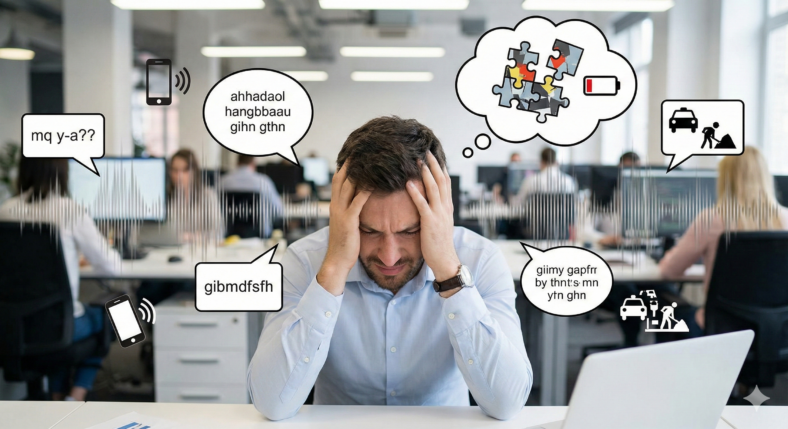
That constant background hum of traffic, the chatter in your open-plan office, the TV playing in the other room while you try to focus: it’s more than annoying, it’s actively degrading your cognitive performance. The science is clear: noise exposure impairs attention, damages memory, slows decision-making, and over time, may accelerate cognitive decline. In short, noise makes you measurably dumber.
Your Brain On Noise
When noise enters your environment, your brain can’t simply ignore it. Even sounds you’ve tuned out consciously still consume cognitive resources. This is why you feel more exhausted after working in a noisy coffee shop than in a quiet library, even if you didn’t notice the noise.
The Cognitive Tax
Research shows that moderate background noise (even below 85 decibels, the occupational safety threshold) negatively affects multiple cognitive domains:
- Reaction time: Slowed responses to stimuli
- Attention: Reduced ability to maintain focus
- Working memory: Difficulty holding and manipulating information
- Long-term memory: Impaired encoding of new information
- Reading comprehension: Decreased understanding of complex material
- Decision-making: More errors and poorer choices
A systematic review in Cognition, Technology & Work found these effects aren’t limited to extreme noise levels. Moderate broadband noise, the kind you encounter in typical urban environments, is enough to measurably impair performance.
The “Irrelevant Speech Effect”
One of the most studied phenomena is the irrelevant speech effect: background conversation disrupts your ability to recall sequential information, even when you’re reading rather than listening. Your brain’s phonological loop (the part that processes language) can’t help but engage with speech sounds, pulling resources away from the task at hand.
This explains why open-plan offices, once celebrated as collaboration hubs, have become productivity graveyards. The constant presence of conversations you’re not part of continuously taxes your working memory.
Children Suffer the Most
The effects of noise on children are particularly alarming. A 2024 meta-analysis of studies spanning from 2001 to 2023 found that noise exposure significantly impairs cognitive performance in children and adolescents, with a standardized mean difference of -0.544, a substantial negative impact.
Specifically:
- Speech noise significantly impairs verbal working memory
- Environmental noise notably affects academic performance, particularly reading
- Children in noisy schools show measurably lower achievement in reading comprehension and memory retention
Here’s what’s troubling: children can’t relocate themselves to quieter environments. If their school is near a busy road, if their home is near a flight path, if their classroom has poor sound insulation, they’re simply stuck with the cognitive penalty.
The Long Game: Noise and Cognitive Decline
Perhaps more concerning than acute effects is what chronic noise exposure does over decades. A study examining adults aged 65 and older found that:
- Each 10-decibel increase in community noise increased the probability of mild cognitive impairment by 36%
- The same increase raised Alzheimer’s disease risk by 29%
The brain literally rewires itself to compensate for difficulty processing speech in noisy environments, according to research from the University at Buffalo. This neural reorganization may come at a cost to other cognitive functions.
Why Noise Hurts Your Brain
Several mechanisms explain noise-induced cognitive impairment:
1. Distraction and Divided Attention
Your brain has limited attentional resources. Noise, especially irregular or meaningful noise (like speech), competes for these resources. Every decibel of background sound is a small tax on your available cognitive bandwidth.
2. Stress Response
Chronic noise exposure activates the hypothalamic-pituitary-adrenal (HPA) axis, your body’s stress response system. Elevated cortisol impairs hippocampal function, damaging the brain region most critical for memory and learning. Noise isn’t just annoying; it’s physiologically stressful.
3. Sleep Disruption
Even sounds that don’t wake you can fragment sleep architecture, reducing time in restorative deep sleep and REM. Poor sleep quality directly impairs next-day cognitive performance, creating a vicious cycle: noisy nights lead to foggy days.
4. Emotional Dysregulation
Noise exposure heightens emotional intensity and reduces emotional regulation capacity. This leads to increased frustration, more errors, and reduced willingness to persist on difficult tasks.
The Counterintuitive Exception: ADHD and White Noise
Interestingly, not everyone suffers equally from noise. Research has found that white noise can actually improve cognitive performance in children with ADHD. The theory is that individuals with low baseline arousal levels need additional stimulation to reach optimal performance, and consistent white noise provides this without the distracting patterns of environmental noise.
Pink noise (a softer variant with more bass frequencies) has also been shown to enhance deep sleep and improve memory consolidation in older adults. The key distinction: these are consistent, meaningless sounds, not the irregular, information-laden noise of conversation or urban environments.
Practical Steps to Protect Your Brain
You can’t eliminate noise from modern life, but you can significantly reduce your exposure:
At Work
1. Push Back on Open-Plan Design
If you have influence over your work environment, advocate for quiet zones, phone booths for calls, and acoustic panels. The productivity gains will far exceed the cost.
2. Noise-Canceling Headphones
Quality noise-canceling headphones are one of the best investments you can make in your cognitive performance. Use them even without music playing.
3. Strategic Scheduling
Save complex cognitive work for your quietest hours. Handle administrative tasks during noisy periods.
At Home
4. Soundproof Your Sleep
White noise machines can mask inconsistent environmental sounds. Blackout curtains with acoustic properties exist. Earplugs designed for sleep are comfortable and effective.
5. Location Matters
When choosing where to live, consider noise exposure. Apartments near major roads, flight paths, or nightlife districts carry a cognitive penalty you’ll pay every day.
6. Create a Quiet Zone
Designate one room in your home as a low-noise environment for focused work, reading, or study.
General Strategies
7. Green Spaces
Research shows that exposure to green spaces is associated with improved cognitive development in children, potentially due to reduced noise levels and increased physical activity. Regular time in parks or nature provides a cognitive reset.
8. Limit Self-Inflicted Noise
Background TV, podcasts while working, music with lyrics during reading: these are voluntary cognitive taxes. If you’re not actively engaging with audio content, turn it off.
9. Sound Masking for Unavoidable Noise
When you can’t eliminate noise, consistent masking sounds (brown noise, pink noise, nature sounds) are less cognitively disruptive than irregular environmental noise.
The Bottom Line
Noise pollution is an invisible tax on human intelligence. Unlike air pollution, which at least has gained public awareness, we’ve largely accepted constant background noise as an inevitable feature of modern life. It isn’t.
The research is unambiguous:
- Noise impairs attention, memory, and decision-making
- Effects begin well below occupational safety thresholds
- Children and the elderly are most vulnerable
- Chronic exposure may accelerate cognitive aging
- The cognitive cost is paid continuously, not just during obvious distraction
Every quiet environment you can create or access is an investment in your cognitive performance. Every unnecessary noise you eliminate gives your brain back resources it desperately needs for thinking, learning, and remembering.
Your brain isn’t designed for the sonic chaos of modern urban life. Protect it.
References
- Szychowska, M., & Bhatt, M. (2023). “A systematic review of the effects of background noise on cognitive performance.” Cognition, Technology & Work. Springer Link
- Paiva, K.M., et al. (2019). “The effects of noise on children’s cognitive performance: A systematic review and meta-analysis.” Environment and Behavior. SAGE Journals
- Weuve, J., et al. (2023). “Residential noise exposure and cognitive decline.” MDPI Behavioral Sciences. MDPI
- Söderlund, G., et al. (2007). “Positive effects of noise on cognitive performance.” PubMed. NCBI
- Papalambros, N.A., et al. (2017). “Pink noise improves sleep and memory in older adults.” Frontiers in Human Neuroscience. Time Magazine Summary
- Dadvand, P., et al. (2015). “Green spaces and cognitive development in schoolchildren.” Time Magazine Summary. Time Magazine
- University at Buffalo (2025). “Brain rewiring in response to speech-in-noise difficulty.” UB News
- Apollo 247 Health Topics. “Noise effects on brain.” Apollo 247

Leave a Reply
You must be logged in to post a comment.