
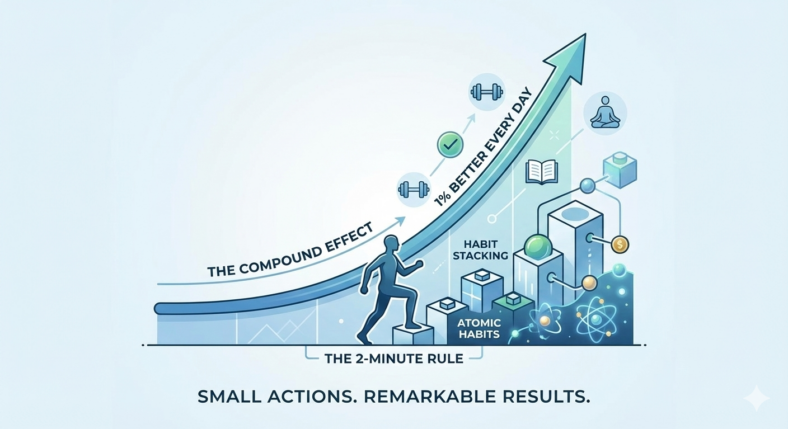
If you’ve ever felt frustrated watching your New Year’s resolutions crumble by February, or wondered why some people seem to effortlessly maintain healthy habits while you struggle, the answer might be simpler than you think. James Clear, author of one of the best-selling books in history, Atomic Habits, reveals that the secret isn’t about motivation or willpower; it’s about understanding how habits actually work and making them so easy that you can’t say no.
THE 2-MINUTE RULE: START SO SMALL IT FEELS RIDICULOUS
The single most important principle for building lasting habits is this: make it easy. Clear introduces what he calls the “2-minute rule,” which suggests you scale down whatever habit you’re trying to build to something that takes two minutes or less to do. Read 30 books a year becomes read one page. Do yoga four days a week becomes take out my yoga mat.
At first, this sounds almost patronizingly simple. But Clear shares the story of a man named Mitch who went to the gym for six weeks with one strange rule: he wasn’t allowed to stay longer than five minutes. He’d drive to the gym, do half an exercise, then drive home. It sounds silly, but what Mitch was actually doing was mastering the art of showing up. He was becoming the type of person who went to the gym four days a week, even if only for five minutes.
The deeper truth here is that a habit must be established before it can be improved. You have to make it the standard in your life before you can optimize and scale it up into something more. As the former Navy SEAL trainer Ed Latimore says, “The heaviest weight at the gym is the front door.”
Clear explains that ambitious people often fall into a trap: they get excited about peak performance and imagine five, six, seven perfect habits all running simultaneously. Instead of asking “What could I do on my best day?” you should ask “What can I stick to even on the bad days?” That becomes your baseline, your first step.
THE ONE HABIT THAT CONTROLS THE NEXT 10 YEARS
Not all habits are created equal. Some habits are upstream from other good things happening. Clear calls these “anchor habits,” and identifying them can be transformative.
For Clear himself, sleep and working out are upstream habits. When he gets his workout in, he experiences a post-workout high for an hour or two, improving his focus and concentration. He sleeps better at night because he’s tired. He eats better, not wanting to “waste” the workout. At no point was he trying to build better focus habits, sleep habits, or nutrition habits, but they all came as natural consequences of getting the workout in.
In business and life, relationships might be the most important upstream factor. Clear notes that opportunities don’t exist in a vacuum; they always come through people. There’s no such thing as an opportunity that isn’t tied to a person. When someone says they wish they could catch their lucky break, what they’re really talking about is interfacing with the person who carries that opportunity.
The question to ask yourself: When you live a good day, when you feel dialed in, what tends to be part of that day? Those are the habits worth focusing on first.
THE 1% CURVE: WHY YOU QUIT RIGHT BEFORE THE BREAKTHROUGH
One of the most powerful concepts in Atomic Habits is the idea of getting 1% better every day. If you improve by 1% each day for a year (1.01 to the 365th power), you end up 37 times better by year’s end. If you get 1% worse each day (0.99 to the 365th power), you decline nearly all the way to zero.
Real life isn’t exactly like compound interest, but this chart captures what the process of behavior change actually feels like. Two things are critical to understand:
First, all the greatest returns are delayed. You are 80% of the way through the curve before it really starts to take off. The early progress doesn’t feel impressive, which is why most people quit too soon.
Second, on day one, the separation between 0.99 and 1.01 is tiny. The difference between eating something healthy for lunch or something unhealthy today is basically nothing. Your body looks the same in the mirror that night. The scale hasn’t changed. There’s no immediate evidence. But the person who always goes to bed a little bit smarter than they were when they woke up, two or five or ten years later, that’s a meaningful difference in wisdom and insight.
The real lesson isn’t about the specific percentage. It’s about adopting an attitude, an approach, a focus on trajectory rather than position. We obsess over position in life: how much money is in my bank account, what’s the number on the scale, what’s the stock price? But if you’re on a good trajectory, all you need is time.
EVERY ACTION IS A VOTE FOR YOUR IDENTITY
One of the most important insights in Clear’s work is how habits reinforce your desired identity. We often start by asking “What do I wish to achieve?” But Clear suggests we should start with “Who do I wish to become?”
Every action you take is like a vote for the type of person you wish to become. Doing one push-up doesn’t transform your body, but it does cast a vote for “I’m the type of person who doesn’t miss workouts.” Writing one sentence doesn’t finish a novel, but it casts a vote for “I’m a writer.” Sending one bit of positive feedback doesn’t make you the world’s best leader, but it casts a vote for “I’m the type of leader who cares about their teammates.”
Individually these are small things, but collectively you build up a body of evidence for being that kind of person. This is different from “fake it till you make it.” Clear encourages letting behavior lead the way. Go outside and shoot a basketball for five minutes; you won’t instantly think “I’m a basketball player.” But do it every day for three, six months, a year, and at some point you cross this invisible threshold where you have to admit playing basketball is kind of an important part of who you are.
Research supports this approach. Studies show people are more likely to vote if you get them to identify as “I’m a voter” rather than asking “Are you voting today?” Imagine two people trying to quit smoking. The first gets offered a cigarette and says, “Oh no thanks, I’m trying not to smoke.” The second says, “Oh no thanks, I’m not a smoker.” The first person is trying to resist something they still see themselves as. The second person no longer sees themselves as the type of person who smokes.
WINNERS AND LOSERS HAVE THE SAME GOALS
This might be the most counterintuitive insight from Clear’s work: goals don’t determine outcomes. If 100 people apply for a job, presumably every candidate has the goal of getting the job. At the Olympic games, everyone competing has the goal of winning gold. Winners and losers have the same goals, so goals cannot be the thing that makes the difference. It has to be something else: the system, the collection of habits that accumulate into a bigger outcome.
Goals can also restrict your happiness. There’s an implicit promise that once you achieve the goal, then you’ll be happy. “Once I write a New York Times bestseller, then I’ll feel better. Once I achieve this certain number on the scale, then I’ll be happy with my body. Once I get to a million dollars in revenue, then I’ll be happy with the business.” You’re constantly pushing happiness off to the next milestone.
The better approach is to fall in love with the process, to fall in love with the lifestyle. Then you can be happy along the way and still achieve the goals and milestones.
Clear offers a powerful metaphor: Imagine an acorn falls from a tree, takes root, becomes a seedling, then a sapling, eventually growing into a mature oak tree. At no point was the acorn criticizing itself for not being a sapling. The sapling wasn’t criticizing itself for not being an oak. It wasn’t dissatisfied with where it was. Nobody was criticizing it. But it kept growing the whole time. Simultaneously, it was both perfect at each stage and yet continued to grow. The reason? That’s just what an oak tree does. It’s encoded for growth.
When Clear looks at himself, he thinks if he puts himself in the right position, that’s how he feels: perfectly happy with where he’s at at each stage, yet encoded to grow. He can both be driven and satisfied, both appreciative of the moment and still moving forward.
THE 4 LAWS OF BEHAVIOR CHANGE
Every habit goes through four stages: cue, craving, response, and reward. You notice something (cue), your brain makes a prediction about what it means (craving), you take action (response), and experience the outcome (reward).
Clear translates this into four laws for building good habits:
1. Make it obvious: The easier a habit is to see or get your attention, the more likely you are to act on it. This is about environment. Put your guitar on a stand in the center of the living room instead of in a case in the closet. Keep your creatine on the kitchen counter where you see it, not hidden in a high shelf behind a cabinet door. One reader even sleeps in her running clothes so she can just put her shoes on and go right out the door.
2. Make it attractive: The more engaging or exciting a habit is, the more likely you are to stick with it. This is where asking “What would this look like if it was fun?” becomes crucial. If you want to be active and fit, there’s a long list of options: gym, kayaking, rock climbing, yoga, Pilates. Take ten minutes to write that list and ask which option is most fun for you. The person who’s having fun is dangerous to compete with because when it gets difficult, they’re way more likely to stick with it.
3. Make it easy: The easier a habit is to perform, the more likely it is to happen. Prime your environment to make the first action easy. Clear sometimes writes the first sentence of what he’s going to write and leaves it on the Google doc. The next day when he comes back, he’s already in. Another strategy: write the topic on a post-it note and put it on top of the keyboard so it’s the first thing you see.
4. Make it satisfying: The more satisfying a habit is, the more likely you are to stick to it in the future. This is about closing the feedback loop of learning. The first three laws make a habit more likely to occur this time; the fourth law increases the odds you do it next time. This is where habit trackers and streaks become powerful. They give you a visual marker of progress and make the habit a little bit like a game.
To break a bad habit, simply invert these four laws: make it invisible, make it unattractive, make it difficult, and make it unsatisfying.
HABIT STACKING: BUILDING NEW HABITS ON OLD ONES
One of the big takeaways from Atomic Habits is that it’s easier to build a new habit if you stack it on top of a habit you’re already doing. This concept comes from Stanford professor BJ Fogg.
The formula is simple: After I [CURRENT HABIT], I will [NEW HABIT].
For example: After I make my morning cup of coffee, I will meditate for 60 seconds. After I make my morning cup of coffee, I will write my to-do list for the day. After I write my to-do list for the day, I will prioritize the tasks and start working on my first task.
The habits you’re already performing each day can become anchors, cues that prompt the new behaviors. As a general rule, it tends to be better to do habits earlier in the day rather than later because the later it gets, the less your day is under your control. More things interrupt, you run lower on time and energy.
But context matters. If you have three little toddlers you’re chasing around in the morning, maybe that’s not a good time to meditate. It’s not a good space for that habit to live. The key is to look at your current habits (perhaps using Clear’s Habit Scorecard, where you write down all your daily habits and mark them with +, -, or = signs) and find the appropriate place to insert the new habit.
WHY YOUR ENVIRONMENT MATTERS MORE THAN WILLPOWER
Clear views environment, both physical and social, almost like a form of gravity. You’re sitting in a chair right now because the environment of the chair is ushering you to that spot. When you leave a room, you go through the door because that’s where the environment is naturally nudging you. You could try to break through a wall or climb through the ceiling, but you won’t. All of our spaces are pulling us toward what is natural and easy.
This applies to habits powerfully. Walk into the rooms where you spend most of your time each day and ask: What is this space designed to encourage? What behaviors are easy here? What behaviors are obvious here? Are the good habits you say you want to build the path of least resistance, or are they fighting against the environment?
Social environment works the same way. You’re always being pulled toward what behaviors are natural in that environment, what the social norms are, what people get praised and rewarded for. This is why one of the biggest lessons for building better habits is to join groups where your desired behavior is the normal behavior.
Studies show it tends to be easier to build a new habit in a new environment. This doesn’t always mean you need a brand new space. You could get a chair and put it in the corner of a room, and that becomes the journaling chair, the only thing you do when you sit in that chair. You’re creating a new context tied to the behavior you want to perform.
Clear shares his own solution: he keeps his phone in another room until lunch each day. It’s only 30 seconds away down the hall, but he never goes to get it. He finds it interesting that he wants it badly enough to check it every three minutes when it’s right by him, but never wants it so badly that he’d walk 30 seconds to get it. Many habits are like that; if you introduce just a little bit of friction, they curtail themselves to the desired degree.
THE PAPER CLIP STRATEGY AND THE POWER OF VISIBLE PROGRESS
Clear shares the story of Trent Duyrsteman, a stockbroker in Abbotsford, Canada in the 1990s. While his colleagues read analyst reports, analyzed company financials, and studied the news, Trent did something simpler. He put 100 paper clips in a jar. Each time he made a sales call, he moved one paper clip to another jar. His goal every day was to move all 100 paper clips from one jar to the other.
With this one simple habit, he became the top performer in the firm and built the biggest book of business over the next couple years. The paper clip strategy did two things: First, it gave him a visual marker of progress throughout the day, turning the work into a bit of a game. Second, it helped him focus on the one thing that really moved the needle. It’s easy to get focused on optimization, looking for the perfect sales strategy or business plan. But sometimes you just need to do the one big thing that matters.
One of the most motivating feelings to the human mind is the feeling of progress. This is why habit trackers and streaks matter so much. Video games have continual, constant forms of progress: your score increases in the corner of the screen, a jingle plays when you pick up a gem, even the pitter-patter of footsteps signals you’re moving forward. Compare that to real life, where you might run every day for a month and still not see a change in your body, or sit in committee meetings every Friday for six months without shipping a feature.
You need to be intentional about creating that feeling of progress in real life. Clear’s parents use a habit tracker for swimming; they put a little X on the calendar each day they swim. It’s a simple template, but it visualizes their progress and gives them a signal they’re moving forward.
THE SECRET TO WINNING IS KNOWING HOW TO LOSE
Perhaps one of the most powerful lessons Clear shares is this: the secret to winning is actually learning how to lose. Top performers in many domains don’t avoid mistakes or slipping up; everyone slips up. But they get back on track quickly.
What you need isn’t a perfect plan or a system that never fails. You need a good plan for getting back on track. If the reclaiming of a habit is fast, the breaking of it doesn’t matter much. You get to the end of the year and it’s just a little blip on the radar.
Clear learned this through sports. In baseball, you’re going to fail in front of the rest of the team. The ball comes to you, you strike out to end the game. That doesn’t feel good, but life moves on. You have to show up again the next time. Each instance of failure is practice for bouncing back. By his senior year, Clear’s attitude was: “I don’t want to lose, but if we’re going to lose, I’d rather it be me. I can take the loss. I can handle it. I’ll give you everything I have to try to win, but if we lose, I’ll be able to bounce back from it.”
This served him well in his entrepreneurial career because things never go your way all the time. You need to be willing to try things, be willing to sometimes look foolish, and still find a way to show up the next time.
Roger Federer, arguably the best tennis player of all time, has won only 53% of the points in his career. Half the time he’s taking losses. But the difference is what he does when he takes the loss, not allowing that missed point to compound into his next shot.
Consistency is often adaptability. It’s flexibility. We tell ourselves stories about mental toughness and discipline, about grinding to make something happen no matter what. But in real life, consistency is actually being flexible. If you don’t have enough energy, you do the easier version. If you don’t have enough time, you do the short version. You find a way to not throw up a zero that day.
As the saying goes: When the storm came, the oak tree fought it and broke, but the willow bent and survived. If you need life to be a certain way to succeed, you become held hostage by the situation. But if you can be adaptable and flexible, you become more resilient.
THE TWO TIME FRAMES THAT MATTER MOST
Clear believes the two time frames that matter most in life are ten years and one hour. Ten years is shorthand for the big meaningful stuff you’re working toward. Most things people really care about are multi-year endeavors: building a business you’re proud of, raising a successful family, having a happy marriage, getting in the best shape of your life, contributing to a cause you care about.
But if you can do one thing each day that’s going to serve you well in ten years, if you can find one hour sometime today to do something that will pay off in a decade, you usually don’t even need to wait ten years. Two, three, or four years into that process, you’re amazed at how much it’s accumulating.
This connects to the concept of systems versus goals. Exceptional founders think about what they can do in the next hour so that in ten years they’re in a different place. Most business problems could be solved by the right person, so the next hour should be spent working on people, on hiring process, on building the team that will build the business.
Clear also introduces the “four burners theory” (not his concept originally), which breaks life into four burners: work, family, friends, and personal health. The idea is you can’t have all four burning at full capacity simultaneously. You might have three going at mid-level, or two burning intensely, but not all four. It’s about recognizing that life involves trade-offs.
Life has a series of seasons and sequences. You might get five or six big ten-year movements in your adult life. Some things make sense to do in a different order than others. If you want to travel the world and party in Ibiza, you’re probably not going to do that in your 60s. Some things are better sequenced in certain spots. Clear has decided that right now, with his kids young, he’s turning the career burner down. “They’re only five once. They only turn six once. They only go to second grade once, and I want to be there for all that.”
MAKE IT FUN OR FAIL
If Clear could add one thing to Atomic Habits, it would be this simple question: What would it look like if this was fun?
The most common New Year’s resolution is to exercise. Many people go to the gym in January because they feel like they should, or society wants them to, or there’s social pressure. But if we came up with a list of what it means to be active and fit, we could come up with dozens of options: gym, kayaking, rock climbing, yoga, Pilates. For any important habit, it’s worth taking ten minutes to write that list and then ask, “What would this look like if it was fun?”
Your habits won’t be the most fun thing you do each day. They won’t always feel like going to a concert. But pretty much any habit can be more fun than the default. And ultimately, if you’re having fun, you’re more likely to stick with it. You’re more likely to persevere.
The person who’s having fun is actually dangerous. You don’t want to compete with them. When it gets difficult, they’re way more likely to stick with it. The person for whom it felt like a hassle from the start, who had a negative frame around the behavior to begin with, as soon as it gets difficult, they’re much more likely to give up.
David Epstein, author of Range, told Clear once: “Grit is fit.” What he means is everyone wants to be gritty, to persevere. But the way you display that grit and discipline is in areas where you’re well-suited, where it’s a good fit for you. If it’s a good fit, if you’re having fun, if you’re interested and engaged, you’re way more likely to stick with it.
The biggest hurdle to clear, for life in general but definitely for habits, is: Are you interested? Are you engaged? Are you having fun? The more you can get closer to that, the more likely you are to persevere and stick with it.
CONCLUSION: IT’S A LIFESTYLE, NOT A FINISH LINE
Habits are not a finish line to be crossed. They’re a lifestyle to be lived. We approach our habits as if there’s a finish line: “Let me do this 30-day cleanse and then I’ll be healthy. Let me do this 90-day sprint and then the product will be shipped.” But most things in life, especially the big important things, are endless battles.
Just because you went to the gym yesterday earns you no bonus points for tomorrow. You still have to show up tomorrow. Just because you were a good spouse yesterday earns you no bonus points for tomorrow. You still have to be loving and caring again.
When people ask Clear how long it takes to form a habit, his answer is sometimes “forever,” because if you stop doing it, it’s no longer a habit. The question isn’t about crossing some 66-day threshold. It’s about living the kind of lifestyle where these behaviors are part of who you are.
Your habits are ultimately about becoming the type of person you want to be. Clear’s objective with Atomic Habits was straightforward: try to be useful and helpful. The stories that matter most to him aren’t the teams that won national championships after implementing his systems (though those are exciting). They’re the messages from people who say, “I finally feel better. I look in the mirror and I’m proud of who I am. My kids tell me they’re excited to see the change in me.”
That’s what it’s always been about: becoming the type of person you want to be, one tiny habit at a time.
REFERENCES:
The Diary of a CEO with Steven Bartlett: Discipline Expert: The Tiny Habit That Finally Makes You Lose Weight! The 2-Minute Trick! – https://primates.life/discipline-expert-the-tiny-habit-that-finally-makes-you-lose-weight-the-2-minute-trick/
James Clear, Atomic Habits: An Easy & Proven Way to Build Good Habits & Break Bad Ones

Leave a Reply
You must be logged in to post a comment.