
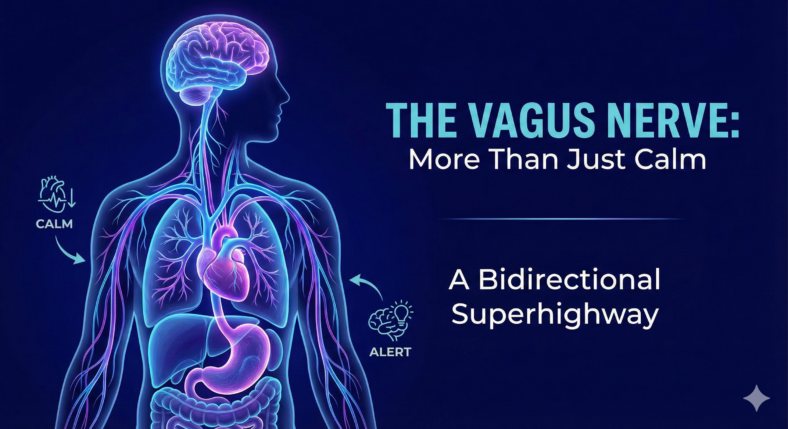
For years, you’ve probably heard about the vagus nerve as some mystical “calming nerve” that you can activate by rubbing behind your ears or doing deep breathing. While there’s truth to some of that, the real story of the vagus nerve is far more fascinating, and understanding it gives you powerful tools to control your mood, alertness, learning ability, and overall health.
What Makes the Vagus Nerve Special
The vagus nerve (cranial nerve 10) isn’t just another nerve. It’s an extensive superhighway of connections linking your brain to virtually every major organ in your body: from your head and neck down through your chest, abdomen, and even into your lower intestines. Unlike other cranial nerves that only connect to the head and neck area, the vagus nerve truly wanders throughout your body (vagus literally means “wandering”).
Here’s what most people get wrong: the vagus nerve isn’t just about calming down. In fact, about 85% of the vagus nerve is sensory, meaning it’s constantly sending information from your body up to your brain. The remaining 15% is motor, sending commands from your brain down to your organs. This bidirectional communication makes it central to everything from heart rate and digestion to alertness and learning.
Beyond Calming: The Vagus Nerve Can Wake You Up
While the vagus is classified as a parasympathetic (calming) nerve, it also has powerful alerting functions that most discussions completely ignore. Here’s how it works:
When you move large muscle groups in your body (especially your legs and trunk), your adrenal glands release adrenaline. This adrenaline binds to receptors on the vagus nerve itself. The vagus then releases glutamate (an excitatory neurotransmitter) in your brainstem, which activates an area called the locus coeruleus. This structure then sprays norepinephrine throughout your brain, dramatically increasing your alertness and motivation.
The practical takeaway: brief moments of physical activity that engages your large muscle groups will help motivate you and increase your neuroplasticity for improved learning and memory. So a short warmup will motivate you for the rest or your workout, or a brief exercise ‘snack’ will help you to maintain focus on your current task.
Heart Rate Variability: Your Health Report Card
High heart rate variability (HRV) is one of the strongest indicators of good health, longevity, and resilience. HRV measures the variation in time between heartbeats, and contrary to what you might think, more variation is better.
Your vagus nerve controls HRV through a specific pathway. Here’s the incredible part: this pathway is coordinated with your breathing. When you inhale, your heart has slightly more space in your chest cavity, blood moves more slowly through it, and your heart rate speeds up. When you exhale, your heart has less space, blood moves faster, and your vagus nerve activates to slow your heart rate down.
The Simple Tool to Boost Your HRV
You can deliberately strengthen this vagal pathway and increase your HRV both during the day and during sleep with one simple practice: extended exhales throughout the day.
10 to 20 times per day, whenever you remember, just do a deliberate, extended exhale. That’s it. You’re activating the vagal brake on your heart rate, and because this pathway is subject to neuroplasticity, using it deliberately strengthens it. This means it will work better automatically in the background, even during sleep, leading to higher HRV and better health outcomes.
Exercise and Brain Plasticity: The Vagus Connection
One of the most exciting discoveries about the vagus nerve involves its role in learning and neuroplasticity. When you do high-intensity exercise, the vagus nerve doesn’t just increase alertness through the locus coeruleus pathway. It also activates nucleus basalis, which releases acetylcholine throughout your brain.
Acetylcholine from nucleus basalis is what scientists call “permissive” for plasticity. It opens a window of opportunity for your brain to rewire itself in response to experience. This is why the 1-4 hours after intense exercise is an ideal time for learning, whether you’re trying to master a new skill, study for an exam, or work on a creative project.
As adults, we can’t learn through passive exposure the way children can. We need both alertness (from norepinephrine) and focus (from acetylcholine) to trigger neuroplasticity. Exercise activates both pathways through the vagus nerve, making it one of the most powerful tools for lifelong learning.
The Bottom Line
The vagus nerve is far more than a calming pathway. It’s a bidirectional superhighway that matches your body’s state to your brain’s state and vice versa. It controls heart rate variability, influences mood through the gut-brain axis, enhances learning and neuroplasticity, and can both calm you down and wake you up, depending on which pathways you activate.
References:
Huberman Lab Podcast: Control Your Vagus Nerve to Improve Mood, Alertness & Neuroplasticity

Leave a Reply
You must be logged in to post a comment.