Sleep is one of nature’s most puzzling paradoxes. Every animal on Earth sleeps, from the tiniest insects to the largest whales. Think about that for a moment: we spend roughly a third of our lives unconscious, vulnerable to predators, and unable to find food or reproduce. If sleep weren’t absolutely fundamental to our well-being, evolution would have eliminated it millions of years ago. Yet it persists across every species, which tells us something crucial: sleep isn’t a luxury or a biological accident. It’s essential to life itself.
Research on sleep evolution shows that despite the apparent vulnerability it creates, sleep provides critical benefits including energy conservation, physical restoration, cognitive enhancement, and immune system support. Studies have found that animals that sleep longer have more robust immune defenses and are less susceptible to parasitic infections.
But what controls this vital process? The answer lies in something so simple yet so profound that most of us take it for granted: light and darkness.
The Master Clock in Every Cell
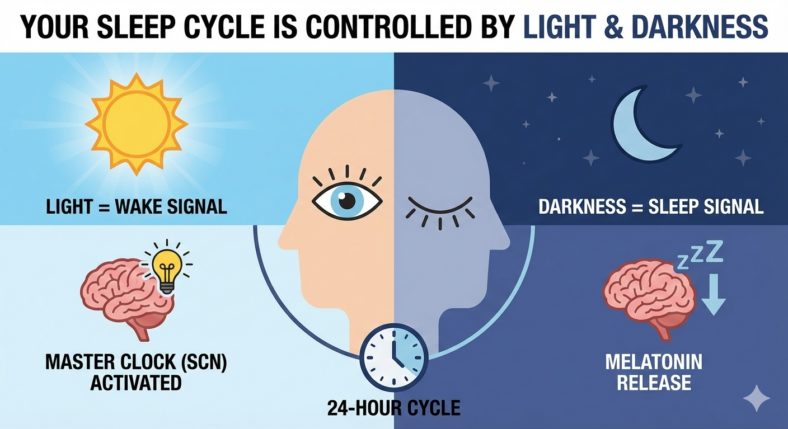
Your body contains a sophisticated timekeeping system called the circadian rhythm, an internal clock that runs on roughly a 24-hour cycle. What many people don’t realize is that this isn’t just one clock. Every single cell in your body has its own circadian clock, orchestrated by a master timekeeper located in a tiny region of your brain called the suprachiasmatic nucleus (SCN).
As Dr. Samer Hattar explains in his discussion with Dr. Andrew Huberman, the circadian rhythm “shows up at every level that we know we studied. It shows up at the level of the cell. It shows up at the level of the tissue, and it shows up at your behavior.” Most tissues in your body have their own clocks, and the role of the SCN is to coordinate all of them.
These cellular clocks govern an astonishing array of functions: when hormones are released, when your body temperature rises and falls, when your metabolism speeds up or slows down, when your immune system is most active, and of course, when you feel alert or sleepy. This isn’t a minor background process. Your circadian rhythm fundamentally shapes every system in your body.
But here’s the critical part: these clocks need to be synchronized with the external world. Otherwise, you’d be out of sync with the day-night cycle, trying to sleep when the sun is blazing and feeling wide awake at midnight. This is where light and darkness come in.
Light: The Signal for Daytime
Your eyes contain specialized cells called intrinsically photosensitive retinal ganglion cells. These cells detect ambient light using a photopigment called melanopsin and send signals directly to your SCN. As noted in research on circadian photoentrainment, these cells work independently of normal vision; even people who are completely pattern-vision blind but still have eyes can entrain to the light-dark cycle through these melanopsin cells. When bright light, especially the blue-enriched light of morning sunlight, hits these cells, it sends a powerful message: it’s daytime. Wake up. Be alert.
This morning light exposure triggers a cascade of biological responses. Your SCN signals the pineal gland to stop producing melatonin, the hormone that makes you sleepy. At the same time, it stimulates the release of cortisol, which helps you feel alert and energized. Your body temperature begins to rise. Your metabolism kicks into gear. You’re being prepared for the active phase of your day.
This process isn’t just about waking up feeling refreshed. Regular exposure to bright light during the day, particularly in the morning hours, keeps your circadian rhythm properly aligned. It’s like setting your watch to the correct time every single day.
Darkness: The Signal for Night
Just as important as light exposure during the day is darkness at night. As the sun sets and light levels drop, your SCN receives the opposite signal: it’s nighttime. Time to wind down and prepare for sleep.
In response to darkness, your pineal gland begins producing melatonin. This hormone doesn’t just make you feel sleepy; it triggers a whole suite of nighttime processes. Your body temperature drops slightly. Your blood pressure decreases. Your immune system shifts into repair mode. Growth hormone is released to facilitate tissue repair and muscle growth. Your brain begins consolidating memories and clearing out metabolic waste products that accumulated during the day.
As Dr. David Berson describes in his discussion on how the brain interprets light, “if you were to measure your melatonin level over the course of the day, you’d see that it’s really low during the day, very high at night. But if you get up in the middle of the night and go to the bathroom and turn on the bright fluorescent light, your melatonin level is slammed to the floor.”
This is why darkness matters so much. Without it, these essential nighttime processes are disrupted.
When the System Gets Disrupted
Here’s where modern life creates a serious problem: we’ve fundamentally altered the light-dark cycle that our bodies evolved to expect. We spend most of our days indoors under artificial lighting that’s far dimmer than natural sunlight. Then we flood our nights with bright lights from overhead fixtures, televisions, smartphones, and tablets.
This creates a confused signal to your circadian system. Insufficient bright light during the day makes your body uncertain about when daytime actually is. Even worse, exposure to bright light at night, actively suppresses melatonin production and tells your brain it’s still daytime.
The consequences aren’t trivial. Research published in Time Magazine has shown that nighttime light exposure increases the risk of cardiovascular disease, including heart disease, atrial fibrillation, and stroke. It impairs glucose tolerance and insulin regulation, raising the risk of type 2 diabetes and obesity. Studies have found that individuals exposed to more than five lux of light during sleep had a significantly higher risk of developing depressive symptoms. The International Agency for Research on Cancer even classifies nighttime light exposure as a probable human carcinogen, based on evidence that circadian disruption may increase cancer risk.
Think about what this means: even a brief exposure to bright light in the middle of the night can slam your melatonin levels to the floor, disrupting every system in your body that depends on proper circadian timing. And excessive darkness during the day, like staying indoors all day long, prevents your circadian rhythm from properly synchronizing with the external world.
Beyond Light: Other Circadian Regulators
While light and darkness are the primary regulators of your circadian rhythm, they’re not the only factors. Your body uses other “time cues” to reinforce its internal clock:
Regular Meal Times: Eating meals at consistent times each day acts as a powerful signal to your circadian system. Your digestive organs, liver, and pancreas all have their own circadian clocks that respond to when you eat. Research shows that starting your day with a substantial, protein-rich breakfast kickstarts your metabolism and reinforces that it’s daytime. Conversely, finishing your last meal at least 2-3 hours before bedtime allows for proper digestion and supports better sleep quality.
Exercise: Regular physical activity, particularly during daylight hours, helps synchronize your circadian rhythm with the external environment. Morning exercise can be especially beneficial for reinforcing your body’s wake signal. However, vigorous workouts close to bedtime can interfere with sleep onset by elevating body temperature and cortisol levels at the wrong time.
Both of these factors work synergistically with light and darkness to keep your circadian rhythm properly aligned. This is why shift workers, who must eat, exercise, and sleep at irregular times, often experience significant health challenges.
Practical Steps to Support Your Circadian Rhythm
Understanding how light, darkness, meal timing, and exercise control your sleep cycle gives you powerful tools to improve your health. Here are the key practices:
1. Get Bright Light in the Morning: Expose yourself to bright light, ideally natural sunlight, within the first hour of waking. Even 10-30 minutes can make a significant difference. If you can’t get outside, consider using a 10,000 lux light therapy box.
2. Maximize Daytime Light Exposure: Spend as much time as possible in naturally lit environments during the day. If you work indoors, position yourself near windows when possible, and take breaks outside.
3. Minimize Light at Night: After sunset, dim your lights. Use warm-toned bulbs rather than bright white LEDs. As discussed in research on light and metabolism, if you need illumination at night, red lights are least disruptive to melatonin production because they contain longer wavelengths that don’t suppress melatonin as aggressively as blue-enriched light.
4. Eliminate Light in Your Bedroom: Sleep in complete darkness. Use blackout curtains, cover or remove electronic device lights, and avoid looking at screens for at least an hour before bed. If you must use screens, use blue light filters or wear blue-blocking glasses.
5. Maintain Consistent Meal Times: Eat your meals around the same time each day, even on weekends. Make breakfast substantial and finish dinner 2-3 hours before bedtime.
6. Exercise Regularly, but Time It Right: Incorporate physical activity into your daily routine, preferably during daylight hours. If evening exercise is your only option, try to finish at least 2-3 hours before bedtime.
7. If You Wake at Night: Use minimal light, just enough to safely navigate. Even brief exposure to bright light can disrupt melatonin production and make it harder to fall back asleep.
The Bottom Line
Your sleep cycle isn’t random. It’s controlled by a sophisticated biological system that has evolved over millions of years to respond to light and darkness. Every cell in your body follows this circadian rhythm, orchestrating everything from hormone release to metabolism to immune function.
In our modern world, we’ve disrupted these ancient signals with too little light during the day and too much light at night, along with irregular meal and exercise patterns. The health consequences are real and significant.
But the solution is remarkably simple: align your behavior with your biology. Get bright light during the day, embrace darkness at night, eat and exercise at regular times, and watch as your sleep quality, energy levels, mood, and overall health improve. Your body knows what to do. You just need to give it the right signals.
References
1. Scientific American: “Why Did Sleep Evolve?” https://scientificamerican.com/article/why-did-sleep-evolve/
2. CORDIS European Commission: “Animals that sleep longer have stronger immune systems, study finds” https://cordis.europa.eu/article/id/30324-animals-that-sleep-longer-have-stronger-immune-systems-study-finds
3. Huberman Lab Podcast: “Essentials: Timing Light for Better Sleep, Energy & Mood | Dr. Samer Hattar” https://primates.life/essentials-timing-light-for-better-sleep-energy-mood-dr-samer-hattar/
4. Huberman Lab Podcast: “Essentials: How Your Brain Functions & Interprets the World | Dr. David Berson” https://primates.life/essentials-how-your-brain-functions-interprets-the-world-dr-david-berson/
5. Huberman Lab Podcast: “Using Red Light to Improve Metabolism & the Harmful Effects of LEDs | Dr. Glen Jeffery” https://primates.life/using-red-light-to-improve-metabolism-the-harmful-effects-of-leds-dr-glen-jeffery/
6. TIME Magazine: “Your Bedroom Probably Isn’t Dark Enough” https://time.com/7339298/dark-bedroom-sleep-night-heart-health/
7. TIME Magazine: “Sleeping in a Dark Room Could Be Healthier” https://time.com/5189387/dark-room-sleep-study/
8. PubMed: “Light-at-night-induced circadian disruption, cancer and aging” https://pubmed.ncbi.nlm.nih.gov/23237593/
9. DC Health: “The Timing Trick: When You Eat Is Just as Important as What You Eat” https://dcforms.dc.gov/sites/default/files/webform/the-timing-trick-when-you-eat-is-just-as-important-as-what-you-eat-7vckzP.html
10. Yahoo Health: “The Daily Schedule That Could Help You Live Longer” https://health.yahoo.com/conditions/cardiovascular-health/articles/daily-schedule-meals-sleep-exercise-153125980.html

Leave a Reply
You must be logged in to post a comment.