

0
0
Summary & Insights

The story of a venture capitalist being fined $100 for showing up two minutes late to a meeting isn’t just about punctuality; it’s a visceral example of how a company’s true culture is defined by concrete actions, not lofty beliefs. Ben Horowitz uses this anecdote to frame a broader conversation about leadership, stressing that culture is the set of daily behaviors—how you treat people, how you respond to emails, whether you keep commitments—that ultimately shape an organization far more than any mission statement. He argues that in times of crisis, this cultural foundation becomes critical, requiring leaders to shift into a “wartime” mentality where being right is more important than being consistent, and where decisive, sometimes unilateral, action is necessary for survival.

Horowitz delves into the monumental impact of individual founders, countering the notion that progress is driven solely by broad cultural forces. He illustrates this with the story of Kip Hickman at Netscape, who single-handedly developed SSL to secure the internet, fundamentally altering the competitive landscape against Microsoft’s proprietary vision. This theme of pivotal individual effort extends to historical figures like Toussaint Louverture, who engineered the only successful slave revolt by building a high-trust military culture from a low-trust slave society. Horowitz emphasizes that in fields like biotechnology, where both innovation and distribution are exceptionally difficult, the founder’s relentless drive isn’t just beneficial—it’s often the difference between a concept changing the world and it languishing for decades.

The discussion then turns to the scalable power of culture as a deliberate competitive advantage. Unlike abstract values, a functional culture must be translated into specific, enforceable actions that everyone understands, like a rule against publicly criticizing entrepreneurs. Horowitz explains that such behavioral codes create a “moat,” aligning a large organization when command-and-control is impossible. He contrasts Amazon’s culture of frugality with Apple’s culture of high design to show how tailored cultures fuel different business models. For founders navigating rapid shifts like the rise of AI, his advice is to immerse themselves deeply rather than make quick assessments, as true mastery of a transformative technology can turn a perceived threat into a dominant advantage.

Surprising Insights

  • Culture as a Competitive Moat: A strong, action-based culture isn’t just internal cohesion; it’s a strategic asset that competitors cannot easily replicate, much like a proprietary technology or data network.
  • The Individual’s Outsized Impact: Contrary to modern trends that emphasize systemic forces, Horowitz argues that history and technology often hinge on single individuals (like Kip Hickman with SSL or Elon Musk with electric cars) who step up at a precise moment.
  • The Samurai Definition of Culture: The concept that culture is a “set of actions, not beliefs” originates from samurai philosophy, which focused on creating durable behavioral codes that lasted for centuries.
  • Neural Networks Were Once a Joke: Horowitz, who studied AI in graduate school, reveals that neural networks were once considered the one approach that would never work, highlighting how rapidly and unpredictably foundational technologies can evolve.
  • Toussaint Louverture’s Cultural Tactics: He built trust in his slave army by enforcing seemingly unrelated rules, like prohibiting officers from adultery, to demonstrate that all commitments mattered—a tactic that won unexpected allies and tactical advantages.

Practical Takeaways

  • Define Culture Through Specific Behaviors: Move beyond vague values like “integrity.” Instead, define what that looks like in action—e.g., “We respond to all partner emails within 24 hours” or “We never publicly criticize an entrepreneur’s mistake.”
  • Embrace “Wartime” Leadership When Necessary: In a drastic market shift, be prepared to act decisively and change course overnight. Communicate that “it’s better to be right than consistent,” and don’t delay tough decisions to maintain consensus.
  • Enforce Cultural Norms with Immediate Feedback: Use clear, tangible consequences (like the famous $10-per-minute late fee) to reinforce core cultural behaviors and ensure they are understood by everyone, especially new hires from different company backgrounds.
  • Treat AI (or Any Disruptive Shift) as a Deep Dive: Avoid superficial analysis. Commit to understanding a fundamental new technology at a granular level, as early, deep expertise can turn a disruptive wave into a core competitive advantage.
  • Audit Your Daily Actions Against Your Stated Culture: Regularly ask if your and your team’s micro-behaviors—meeting punctuality, communication style, decision-making processes—align with the culture you aspire to build.

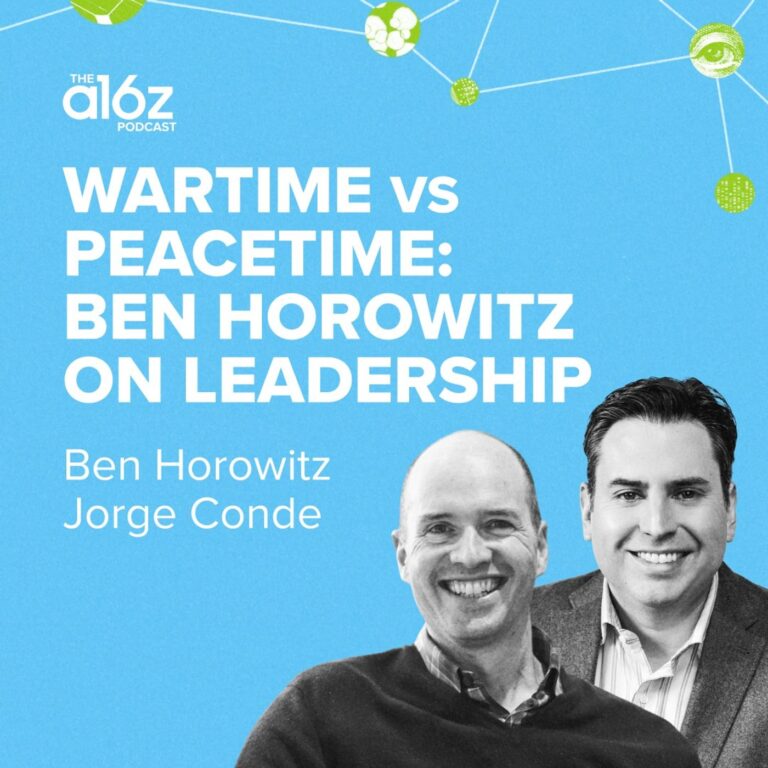
In this exclusive conversation from a16z’s Bio and Health BUILD Summit, founding partner Ben Horowitz sits down with general partner Jorge Conde. Originally released in August 2023, the episode covers everything from the inspiration behind Ben’s book The Hard Thing About Hard Things and how the open internet was secured, to the difference between wartime and peacetime CEOs, what it really means to scale culture, and how bio and healthcare innovation differs from other forms of technology.

Ben’s Book: https://www.amazon.com/Hard-Thing-About-Things-Building/dp/0062273205


Resources:

Follow Ben on Twitter: https://x.com/bhorowitz

Follow Jorge on Twitter: https://x.com/jorgecondebio


Stay Updated:

If you enjoyed this episode, be sure to like, subscribe, and share with your friends!

Find a16z on X: https://twitter.com/a16z

Find a16z on LinkedIn: https://www.linkedin.com/company/a16z

Listen to the a16z Podcast on Spotify: https://open.spotify.com/show/5bC65RDvs3oxnLyqqvkUYX

Listen to the a16z Podcast on Apple Podcasts: https://podcasts.apple.com/us/podcast/a16z-podcast/id842818711

Please note that the content here is for informational purposes only; should NOT be taken as legal, business, tax, or investment advice or be used to evaluate any investment or security; and is not directed at any investors or potential investors in any a16z fund. a16z and its affiliates may maintain investments in the companies discussed. For more details please see a16z.com/disclosures.

Stay Updated:

Find a16z on X

Find a16z on LinkedIn

Listen to the a16z Show on Spotify

Listen to the a16z Show on Apple Podcasts

Follow our host: https://twitter.com/eriktorenberg


Please note that the content here is for informational purposes only; should NOT be taken as legal, business, tax, or investment advice or be used to evaluate any investment or security; and is not directed at any investors or potential investors in any a16z fund. a16z and its affiliates may maintain investments in the companies discussed. For more details please see a16z.com/disclosures.

Hosted by Simplecast, an AdsWizz company. See pcm.adswizz.com for information about our collection and use of personal data for advertising.

Leave a Reply

a16z Podcasta16z Podcast
Let's Evolve Together
Logo