

Summary & Insights





The universe might literally want us to become more sophisticated, to replicate and build structure, as a thermodynamic counterforce to entropy. This idea of a “pronatalist universe” forms the philosophical bedrock of Marc Andreessen’s case for embracing radical technological acceleration, a conversation that spans from the origins of AI in the 1940s to the immediate political battles over its future today. Andreessen argues that human progress is fundamentally tied to our ability to harness technology to improve material conditions, yet we are living in a schizophrenic era: while the digital world of “bits” has advanced spectacularly, the physical world of “atoms”—energy, housing, transportation—has been artificially stagnated since the 1970s due to systemic fear and gatekeeping.
This stagnation, he contends, is not an accident but a choice, exemplified by the deliberate suppression of nuclear power. Despite it being a safe, zero-emissions energy solution, a political movement successfully blocked its development, a decision with dire, cascading consequences like European energy dependence on Russia. Andreessen sees this pattern now repeating with artificial intelligence. A coalition he labels the “AI doomers,” often aligned with the Effective Altruism movement, is pushing for severe restrictions or outright bans on AI development, fueled by exaggerated existential risks. In opposition, the emerging philosophy of “Effective Accelerationism” (e/acc) champions the opposite: accelerating technological progress to improve human flourishing, viewing intelligence as a vital resource to be expanded, not contained.
Andreessen remains cautiously optimistic, grounding his outlook not in utopianism but in engineering and material outcomes. He believes the impulse to halt technology is primarily an elite phenomenon, while the masses eagerly adopt and benefit from tools like ChatGPT. The immediate future hinges on whether we can overcome learned helplessness and self-defeating policies. Over the next 50 years, the convergence of AI, potential breakthroughs like room-temperature superconductors, and a reconsideration of nuclear energy could lead to a significant step-function improvement in human quality of life, curing diseases and creating abundance. The long-term, millennium-spanning future may involve neural augmentation and space exploration, but the pressing fight is to win the next few decades of technological development against forces of stagnation.
Surprising Insights
- The thermodynamic argument for life: Accelerationism is underpinned by physicist Jeremy England’s theory that life itself is a thermodynamic inevitability—a structure for absorbing energy and exporting entropy. The universe isn’t indifferent; it’s inherently “pronatalist,” favoring replication and complexity.
- Elites vs. masses on technology: Andreessen draws a stark divide: fear and opposition to new technologies like AI and social media are primarily elite preoccupations focused on maintaining gatekeeping power, while the global masses adopt and derive clear utility from them, as seen in widespread public use and trust in tech.
- Nuclear power as the tell: The case of nuclear power reveals a potential hidden agenda within some environmental movements. If the stated goal is solving climate change, nuclear is a silver bullet. Active opposition to it, therefore, suggests a deeper goal might be “degrowth” and population reduction, not merely emissions reduction.
- Historical precedent for banning math: The current regulatory push to constrain AI by controlling compute and algorithms eerily mirrors past efforts to ban cryptography (which is just math) in the 1990s and even contemporary movements in education to remove advanced math like algebra and calculus from school curricula.
Practical Takeaways
- Adopt and normalize advanced tools: Counter techno-pessimism by personally engaging with technologies like AI. Use state-of-the-art models freely available online to enhance your own work and creativity, demonstrating their concrete benefits.
- Advocate for energy abundance: Support the development and deregulation of nuclear energy (fission now, fusion in future) as a critical path to clean, abundant power, which is the foundational input for all other technological progress and geopolitical stability.
- Identify and challenge gatekeepers: Be skeptical of narratives that new technologies must be strictly controlled by existing institutions. Scrutinize whether regulations from “safety” or “equity” are genuinely protective or are tools for maintaining a status quo hierarchy.
- Focus on material outcomes: Evaluate technologies and policies based on their tangible impact on human material flourishing—productivity, health, and standard of living—rather than abstract, often fear-based, risk assessments.
- Engage with accelerationist ideas: Explore the writings of Nick Land, the cybernetics tradition, and the work of physicists like Jeremy England to understand the intellectual foundations arguing for acceleration as a natural and positive force.
Generative AI tools like DALL-E, Midjourney, and Stable Diffusion have taken the world by storm in recent months, wowing the masses with their uncanny ability to produce images via text prompts.
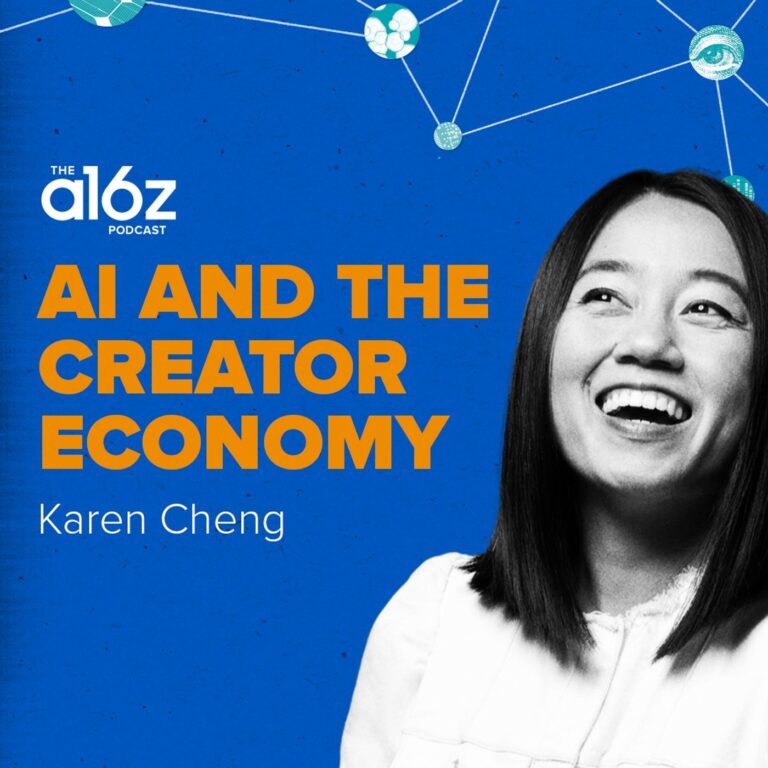
In this interview, we’ll chat with Karen Cheng about how she’s leveraged these tools among others, with a focus on how this new paradigm is reshaping the creator landscape. You’ll get to hear the behind the scenes of many of her viral works, including a video of her becoming a lawnmower, her AI-generated Cosmo magazine cover, her DALL-E fashion show, her transforming iconic art into 3D museums to explore, and much, much more. By the end of this episode, listeners should have a better understanding of the new tools at their fingertips (literally!), how AI can indeed enhance the creative process, and the second-order effects of these innovations, like how creators are paid.
Since we’re just at the beginning of the AI era, this is just the beginning of our coverage as well.
Timestamps:
00:00 – Intro
02:59 – Karen’s journey to content creator
06:32 – Creative unlocks for viral content
09:28 – The changing social media landscape
12:08 – Innovating with AI
14:59 – Unique AI tools available today
17:52 – How AI tools might differentiate
21:04 – Cosmo’s first AI-generated magazine cover
24:19 – Inpainting, outpainting, and the fungibility of artists
31:54 – AI enhancing the creative process
32:39 – The virality of optimism vs pessimism
38:19 – Turning attention into business
43:13 – IP and ownership in the age of AI
46:18 – The downward pricing pressure of AI
47:21 – Is generative AI still a gimmick?
53:32 – The adaptiveness of humans
58:26 – The importance of AI ethics
Resources:
Cosmo magazine cover and tutorial
DALL-E fashion show and tutorial
DALL-E outpainting announcement
I spent $15 in DALL·E 2 credits creating this AI image
Stay Updated:
Find us on Twitter: https://twitter.com/a16z
Find us on LinkedIn: https://www.linkedin.com/company/a16z
Subscribe on your favorite podcast app: https://a16z.com/podcasts
Follow our host: https://twitter.com/stephsmithio
Please note that the content here is for informational purposes only; should NOT be taken as legal, business, tax, or investment advice or be used to evaluate any investment or security; and is not directed at any investors or potential investors in any a16z fund. For more details please see a16z.com/disclosures.
Leave a Reply
You must be logged in to post a comment.