

Summary & Insights





The economic scale of AI-assisted software development is staggering—with the global developer workforce generating an estimated $3 trillion in value, this technology isn’t just automating tasks but fundamentally reshaping the entire software value chain. A16Z partners Yoko Lee and Guido Appenzeller argue that AI coding represents the first truly massive market for AI, comparable to the GDP of a major nation. This disruption extends far beyond just writing code; it’s transforming every stage of the development lifecycle, from planning and specification to review, deployment, and maintenance.
The conversation delves into the shifting “developer loop,” where AI agents are beginning to handle not only code generation but also tasks like reviewing pull requests, updating documentation, and even exploring multiple implementation paths in parallel. This is leading to the rise of “vibe coding”—the ability to quickly create personalized, bespoke software for individual needs—which could vastly increase the total amount of software in the world. However, this agent-centric future introduces new challenges, such as the need for specialized agent environments and tools, and a reevaluation of foundational developer platforms like GitHub, which were built for human, not AI, workflows.
A critical tension emerges around the role of human oversight. While AI can generate thousands of lines of code instantly, human developers are increasingly becoming high-level directors and context engineers, prompting and steering AI agents rather than writing line-by-line. The most immediate and measurable ROI for enterprises is appearing in an unexpected area: legacy code migration, such as converting COBOL to Java, where AI can dramatically accelerate projects previously deemed too costly or complex. Looking ahead, the ecosystem is ripe for new startups that either reinvent traditional developer tools for an AI-native world or build entirely new infrastructure designed specifically for AI agents as the primary user.
Surprising Insights
- The clearest and fastest return on investment for AI in enterprise coding isn’t in greenfield development, but in modernizing legacy systems (e.g., COBOL to Java), where AI can double the speed of migration.
- AI coding tools are so effective that the bottleneck is shifting from writing code to reviewing it, forcing a rethinking of whether line-by-line PR reviews are still the right abstraction or if verification should happen through automated testing in a sandbox environment.
- There’s a potential for a renaissance in obscure or legacy programming languages, as AI enables developers to work with them using natural language, lowering the barrier to entry and maintenance.
- The developer’s cost structure is changing; an engineer’s “infrastructure” now includes a continuous stream of LLM tokens, which can become a significant expense, sometimes rivaling or exceeding labor costs in low-wage regions.
- Foundational platforms like GitHub, designed for human commit rhythms and collaboration, may be ill-suited for AI agents that operate at high frequency and need different coordination mechanisms, spawning a need for new, agent-native version control systems.
Practical Takeaways
- Treat AI Agents as Your Customer: When building new developer tools, consider the agent’s needs—such as efficient context retrieval, sandboxed testing environments, and orchestration layers—as primary design requirements.
- Invest in Context Engineering: For both human and AI efficiency, proactively create and maintain high-quality, structured documentation and code abstractions. This reduces the need for massive context windows and makes agents faster and more accurate.
- Embrace “Vibe Coding” for Customization: Leverage AI coding assistants to quickly build personalized tools and automate niche workflows that commercial software doesn’t address, unlocking productivity gains at an individual level.
- Re-evaluate Development Metrics: Move away from traditional productivity proxies like lines of code or number of commits. Focus instead on outcomes delivered, and explore new metrics related to effective prompt engineering, token efficiency, or the successful orchestration of multiple agents.
- Augment, Don’t Just Automate, Code Review: Integrate AI tools into your review process to check for security, spec adherence, and coding standards, allowing human reviewers to focus on higher-level architecture and design implications rather than syntax.
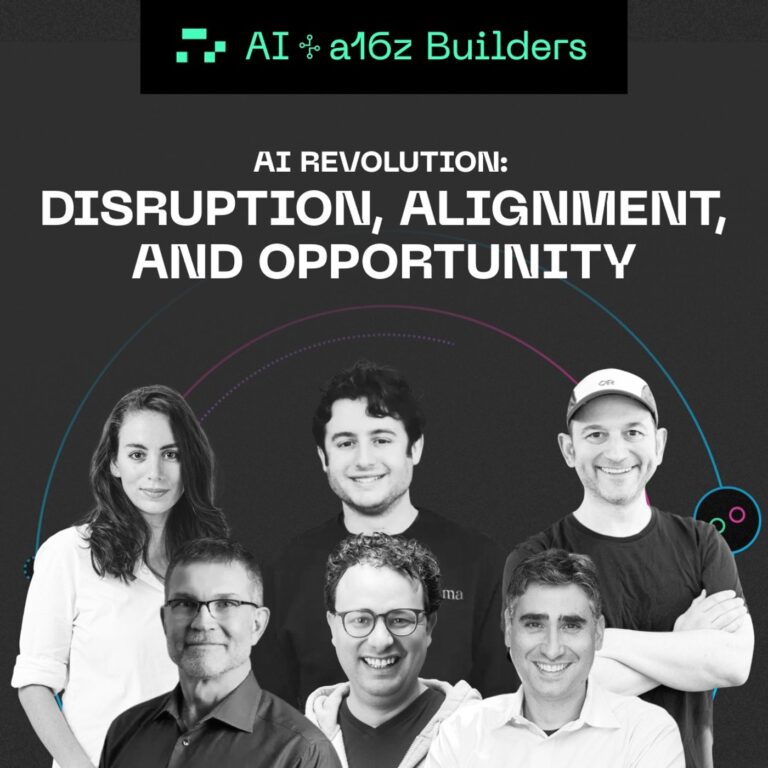
The AI Revolution is here. In this episode, you’ll learn what the most important themes that some of the world’s most prominent AI builders – from OpenAI, Anthropic, CharacterAI, Roblox, and more – are paying attention to. You’ll hear discussion around the real-world impact of this revolution, on industries ranging from gaming to design, and the considerations around alignment along the way.
This footage is from an exclusive event, AI Revolution, that a16z ran in San Francisco recently. If you’d like to access all the talks in full, visit a16z.com/airevolution.
Topics Covered:
00:00 – AI Revolution
02:39 – Putting technology in users’ hands
08:21 – AI alignment and safety
21:44 – Future opportunities
Resources:
Catch the all the talks at https://a16z.com/airevolution
Stay Updated:
Find a16z on Twitter: https://twitter.com/a16z
Find a16z on LinkedIn: https://www.linkedin.com/company/a16z
Subscribe on your favorite podcast app: https://a16z.simplecast.com/
Follow our host: https://twitter.com/stephsmithio
Please note that the content here is for informational purposes only; should NOT be taken as legal, business, tax, or investment advice or be used to evaluate any investment or security; and is not directed at any investors or potential investors in any a16z fund. a16z and its affiliates may maintain investments in the companies discussed. For more details please see a16z.com/disclosures.
Leave a Reply
You must be logged in to post a comment.