

Summary & Insights





Imagine a world where you need a license to cut hair but not to build software that can reshape the global economy—a stark illustration of the fundamental clash between the rapid, permissionless innovation of the internet and the slow-moving, regulatory power of the state. This core tension frames a wide-ranging discussion between tech thinkers Balaji Srinivasan and Steven Sinofsky, who dissect the chaotic state of mergers and acquisitions, antitrust enforcement, and the future of AI. They argue that aggressive regulatory actions over the past several years have created a “desert” for tech exits, forcing companies to stay private longer and chilling the M&A market that often fuels innovation and provides crucial liquidity for startups.
The conversation explores how this regulatory pressure is paradoxically making large tech companies stronger while spawning novel, complex deal structures to circumvent scrutiny. Examples like the “aqua-fire” model—where a big company buys only a startup’s top talent and leaves a shell company behind, as seen in the Windsurf/Google deal—highlight the creative, and often messy, workarounds emerging in response to antitrust roadblocks. The hosts critique the regulatory mindset, which they see as rooted in a pre-digital, zero-sum worldview ill-equipped to handle the dynamic, network-driven nature of modern tech markets. They point to the retconning of successful acquisitions like Instagram and YouTube, which were widely criticized at the time but later held up as examples of monopolistic power, as evidence of flawed regulatory logic.
Ultimately, the dialogue frames this as a deep power struggle between “the network” (decentralized, global tech ecosystems) and “the state” (centralized regulatory authority). As the network’s influence has grown to rival that of nations, the state has pushed back to reclaim its primacy. The discussion warns that this collision is now reaching a critical point in the age of AI, with copyright battles, energy constraints, and geopolitical competition from China threatening to stifle U.S. innovation. The path forward, they suggest, may lie not in fighting for regulatory change within a hostile system, but in building and investing across a diverse landscape of more innovation-friendly jurisdictions worldwide.
Surprising Insights
- M&A is statistically a destroyer of value, not a monopolistic cheat code. Most corporate acquisitions fail, and business literature shows they are net value-destructive. Regulators paradoxically attack the rare, successful acquisitions while ignoring the far more common failures.
- Blocking acquisitions can strengthen, not weaken, big tech companies. When regulators prevent big companies from buying startups, it denies those startups crucial exit capital. This dries up funding for future competitors and forces big companies to build instead of buy, often making them more capable and resilient in the long run.
- The “aqua-fire” is a new, counterintuitive exit structure born from regulatory pressure. Distinct from an acquisition or an “aqua-hire,” an “aqua-fire” involves a big company buying only a startup’s key talent and leaving a shell company with money but no status. This creates complex human and financial incentives that traditional deal structures never anticipated.
- Regulators often lack the numerical and scaling intuition common in tech. The discussion points to repeated public confusions (e.g., equating millions with billions) as symptomatic of a regulatory culture selected for verbal and legal skills, not the mathematical and scaling mindset required to govern exponential technologies.
Practical Takeaways
- For founders and startups: Anticipate regulatory roadblocks in your exit strategy. Consider contractual innovations like a “non-key man” clause that designates and compensates a person to manage an orderly shutdown or “aqua-fire” scenario, protecting both the team left behind and the company’s reputation.
- For investors and dealmakers: Recognize that M&A follows a power law; most deals fail, but the few transformative successes justify the portfolio. In a restrictive environment, creative deal structuring is not just financial engineering but a necessary adaptation for capital to flow.
- For the tech industry broadly: Shift from being reactive to regulators to being proactively geopolitical. Build a “sales team” to advocate for pro-innovation legislation not just nationally, but across 50 U.S. states and 190 countries, leveraging jurisdictional competition to find favorable environments for building.
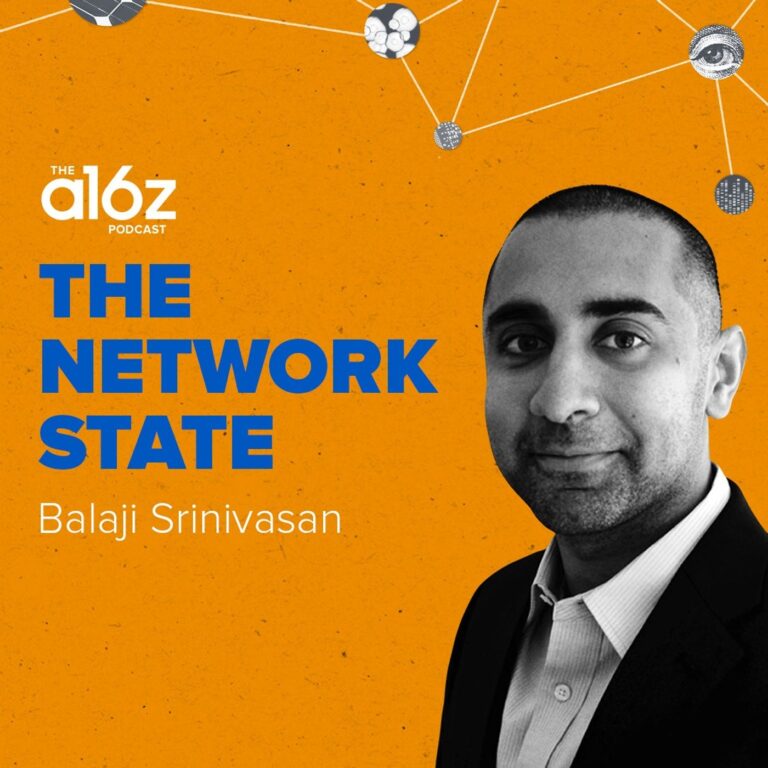
In this episode, we’ll explore the concept of The Network State with Balaji Srinivasan. As the world becomes more digital, it also becomes more distributed. This is obvious on the individual level – how you order goods, the way you chat with friends, and the news you consume… all from a handheld computer. It’s also becoming more obvious at the company level. The pandemic shook the world into remote work and many companies have decided that maybe work can be done in ways they never imagined. But what about the state – whatever that means? Could the network rival the state?
In this episode we’ll explore what a nation state even is and how it may be challenged by a new Leviathan: the network. We also cover the difference between a nation and a state, how constants become variables, the cloud continent, digital power, your identity stack, calibrating risk, polycentric law, cloud regulations, building fast with atoms, founding vs inheriting, the powerful vs the powerless, and just about everything in between.
Timestamps:
0:00 – Introduction
2:41 – Nation vs state
14:38 – Constants becoming variables
16:12 – The cloud continent
20:10 – The three leviathans
30:00 – Digital power
37:20 – The identity stack
53:22 – Cloud first, land last
55:49 – Diplomatic recognition
1:01:47 – Root access to land
1:06:35 – Calibrating risk as society
1:16:13 – Regulatory harmonization
1:28:15 – Polycentric law
1:34:49 – Building fast with atoms
1:38:57 – Looking to history
1:42:00 – Founding vs inheriting
1:50:46 – The one commandment
2:17:33 – The powerful vs powerless
2:28:46 – The competition for people
2:33:45 – Historical lines
2:42:23 – v3 of governance
Resources:
Balaji’s Twitter: https://twitter.com/balajis
Balaji’s website: https://balajis.com/
The Network State: https://thenetworkstate.com/
Stay Updated:
Find us on Twitter: https://twitter.com/a16z
Find us on LinkedIn: https://www.linkedin.com/company/a16z
Subscribe on your favorite podcast app: https://a16z.com/podcasts
Follow our host: https://twitter.com/stephsmithio
Please note that the content here is for informational purposes only; should NOT be taken as legal, business, tax, or investment advice or be used to evaluate any investment or security; and is not directed at any investors or potential investors in any a16z fund. For more details please see a16z.com/disclosures.
Leave a Reply
You must be logged in to post a comment.