

Summary & Insights





What happens to a multi-billion dollar industry when the value moves “up the stack”? This question sits at the heart of the current AI gold rush, as tech analyst Benedict Evans compares the trajectory of Large Language Models (LLMs) to the history of the mobile internet. Just as telecom companies spent billions building the sophisticated infrastructure of 3G and 4G only to see the real profits captured by the apps that sat on top of those networks, the “foundation model” providers may be building a commodity that others will eventually monetize.
The most immediate evidence of a successful “product-market fit” is currently found in agentic coding. While many industries are still scratching their heads over how to integrate AI into a daily workflow, software developers have already jumped the bridge. This shift is transforming the very nature of engineering, moving the conversation from theoretical productivity gains to the actual automation of junior-level tasks. However, this success in coding stands in stark contrast to the broader consumer market, where the majority of users still engage with AI on a weekly rather than daily basis, suggesting that the “Nirvana” of a truly indispensable daily AI tool has not yet arrived.
Looking forward, the real transformation likely lies not in doing old tasks faster, but in doing things that were previously impossible. Evans suggests that the next wave of value will be found in “half AI, half industry” questions—where the solution requires deep domain expertise in law, finance, or media combined with AI’s capability. The goal isn’t just to make a better spreadsheet or a faster email, but to identify the “holes in the universe”—problems that businesses didn’t even realize existed until a new level of abstraction made the solution possible.
Surprising Insights
- The Infrastructure Trap: There is a strong historical precedent for “infrastructure” layers (like telcos or chip makers) becoming low-margin commodities while the application layer captures nearly all the economic value.
- The “Average” Problem: LLMs are exceptionally good at providing the “average” answer—the way anyone or any associate would do a task—but they struggle in areas where the value is derived from doing something specifically different from the norm.
- The Jevons Paradox in AI: Making a task cheaper (like generating a financial model) doesn’t necessarily save money; it often leads to an explosion in the volume of that task being performed, which may actually keep costs flat while increasing total output.
- Non-Linear Progress: Unlike previous shifts (like the PC or mobile), the physical limits of AI are not yet known. We don’t know the floor for pricing or the ceiling for capability, making current valuations a gamble on an unknown equilibrium.
Practical Takeaways
- Avoid “Better” and Aim for “New”: Don’t focus on using AI to do old tasks 10% faster. Instead, ask: “What is now possible that was completely cost-prohibitive or physically impossible two years ago?”
- Focus on the “Edge”: Look for opportunities in on-device AI. As compute becomes “free” for the developer via the user’s hardware, the marginal cost of running models drops, opening new business models.
- Combine AI with Deep Domain Expertise: The highest value is currently found at the intersection of AI and specific industry knowledge (e.g., how a law firm actually operates internally), rather than in general-purpose chatbot tools.
- Audit Your “Junior” Workflows: For managers, evaluate whether you are hiring junior staff for the tasks they perform or the outcomes they provide. If the tasks are being automated, the hiring and training model for the next generation of professionals must be fundamentally rewritten.
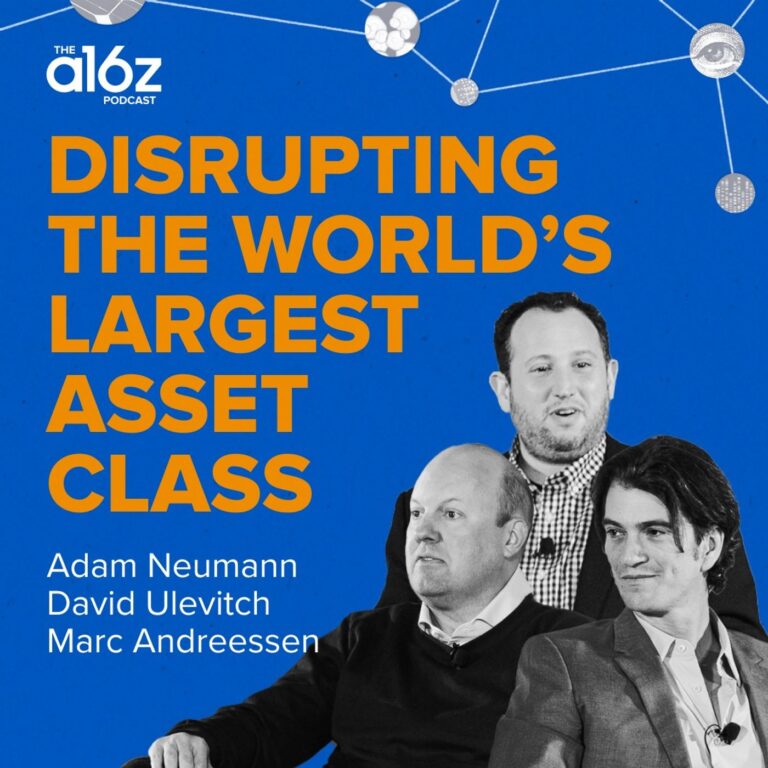
Back in August, after a16z announced our investment into Adam Neumann’s new company, Flow, it felt like almost everyone – whether it was other VCs, founders, or journalists – had something to say.
But the one person that you didn’t hear from was Adam himself.
In this never-before shared footage from a16z’s American Dynamism Summit in Washington DC, Adam Neumann sits down with Marc Andreessen and David Ulevitch, to discuss the opportunities that have emerged from post-pandemic shifts in both work and home, and what Flow is doing to capitalize.
Find the full library of American Dynamism Summit recordings at a16z.com/ad-summit.
Timestamps:
- 00:00 – Introduction
- 01:40 – Getting back in the arena
- 09:03 – The opportunity in housing
- 16:19 – Lessons from WeWork
- 19:13 – Work & home post-pandemic
- 27:34 – Moving to the cloud
- 34:23 – Office serendipity
- 37:51 – Building Flow
- 43:51 – Cities as startups
Resources:
Flow’s website: https://www.flow.life/
American Dynamism recordings: https://a16z.com/ad-summit
Stay Updated:
Find us on Twitter: https://twitter.com/a16z
Find us on LinkedIn: https://www.linkedin.com/company/a16z
Subscribe on your favorite podcast app: https://a16z.simplecast.com/
Follow our host: https://twitter.com/stephsmithio
Please note that the content here is for informational purposes only; should NOT be taken as legal, business, tax, or investment advice or be used to evaluate any investment or security; and is not directed at any investors or potential investors in any a16z fund. For more details please see a16z.com/disclosures.
Leave a Reply
You must be logged in to post a comment.