

Summary & Insights





Could a car that rotates 360 degrees in place or floats like a boat be the catalyst for a global industrial shift? This is the reality of the modern Chinese auto industry, which has transitioned from producing “pitiful” replicas of 1950s Russian cars to becoming the world’s largest car exporter. While American consumers are largely shielded from this shift by strict tariffs and security regulations, the rest of the world is seeing a flood of high-tech, affordable vehicles from brands like BYD and Xiaomi that are challenging the dominance of legacy giants in Detroit, Stuttgart, and Nagoya.
The rise of this “world-beating” industry wasn’t an accident, but a calculated, decades-long state strategy. Beginning with Deng Xiaoping’s joint-venture requirements—which forced foreign automakers to share technology with Chinese partners—Beijing systematically absorbed Western know-how. The real pivot, however, occurred when China realized it could never beat the West at the internal combustion engine. By pivoting aggressively to electric vehicles (EVs) through the “Made in China 2025” initiative and strategically welcoming Tesla to build factories on their soil, China essentially used Tesla as a catalyst to modernize its own supply chain and shift consumer perception of EVs from “unreliable” to “sexy.”
This transformation has created an existential threat to U.S. national security, as the automotive “stack”—batteries, chips, and software—is the same foundation used for drones and missiles. With China controlling roughly 70% of global battery manufacturing and 90% of graphite processing, the U.S. faces a critical vulnerability. To compete, the conversation is shifting away from traditional Detroit manufacturing toward a “West Coast” model of software-defined vehicles and autonomous driving, where the U.S. still maintains a slight lead.
Surprising Insights
- The Tesla “Red Carpet”: China allowed Tesla to own 100% of its operations (waiving the usual joint-venture rule) not out of generosity, but to ensure Tesla’s manufacturing secrets and supply chain capabilities would “leak” to local Chinese automakers overnight.
- The “Millet” Brand: One of the top new car makers, Xiaomi, is actually a phone company. Its name means “millet,” a tribute to Mao Zedong’s phrase “rifles and rice millets.”
- The Invisible Tide: While Chinese cars are nearly non-existent in the U.S., they are pouring into markets like Mexico, the UK, Australia, and Indonesia, making the U.S. an “island” of isolation.
- The “Lying Flat” Trend: A generational shift is occurring where younger, more affluent Chinese citizens are rejecting the grueling work culture of their parents, creating a potential internal friction in China’s drive for industrial dominance.
Practical Takeaways
- Shift Perspective on EVs: View the electric vehicle not just as a consumer product, but as a “software-defined vehicle” where the computer is the heart and the car is simply the wrapper.
- Prioritize Vertical Integration: Follow the “Elon Musk model” of bringing key components in-house; outsourcing for short-term cost savings often kills long-term internal innovation.
- Focus on Autonomy: For those in tech or logistics, the real “win” in the global auto war will be whoever perfects autonomous ride-sharing at scale, as consumer trends in dense urban areas are shifting away from car ownership toward mobility services.
- Audit Supply Chain Vulnerabilities: Businesses relying on battery technology or rare earth minerals should diversify sources away from China to avoid “choke points” in graphite and cell processing.
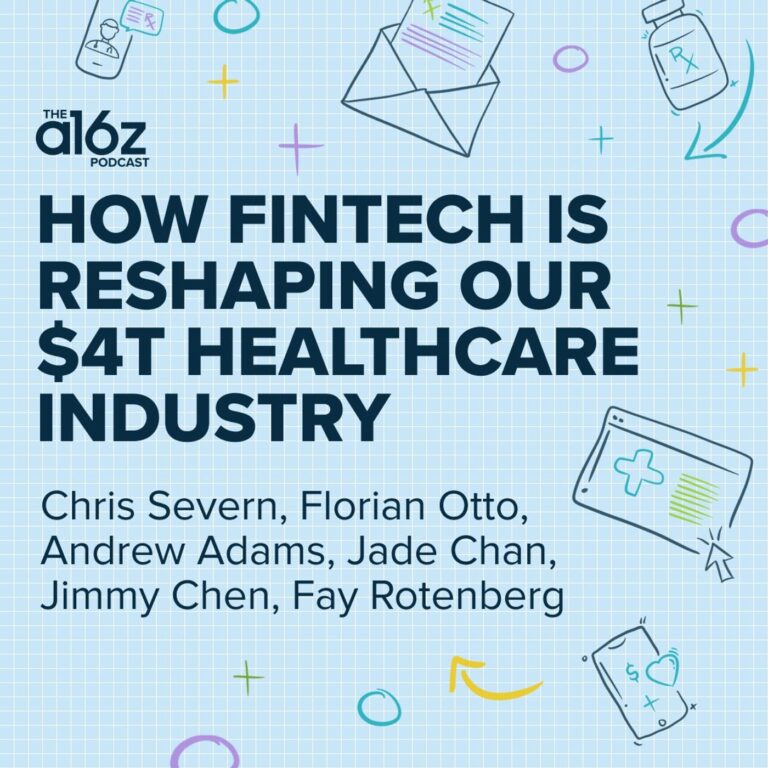
In this episode, you’ll hear directly from 6 founders trying to reinvent the healthcare system with the help of Fintech.
They’re tackling everything from the lack of price transparency, the complexity of billing, getting clinics paid on time, mental health support for the masses, virtual first-care, and the millions of Americans about to lose access to Medicaid.
Topics Covered:
- 00:00 – The biggest problems in healthcare
- 02:22 – The lack of price transparency
- 07:13 – The complexity of medical billing
- 14:32 – Getting health clinics paid on time
- 20:00 – Mental health support for the masses
- 24:58 – Millions about to lose Medicaid
- 29:12 – Adopting virtual-first care
Resources:
- Learn more about the intersection of Healthcare and Fintech: https://a16z.com/healthcare-meets-fintech/
- Check out Turquoise: https://turquoise.health/
- Check out Cedar: https://www.cedar.com/
- Check out Juniper: https://www.juniperplatform.com/
- Check out Headway: https://headway.co/
- Check out Propel: https://www.joinpropel.com/
- Check out Firefly: https://www.firefly.health/
- Find Chris on Twitter: https://twitter.com/crsevern?lang=en
- Find Florian on Twitter: https://twitter.com/flottobrasil?lang=en
- Find Jade on Linkedin: https://www.linkedin.com/in/jadeyychan/
- Find Andrew on Twitter: https://twitter.com/andrewlangadams?lang=en
- Find Jimmy on Twitter: https://twitter.com/jimmychen?lang=en
- Find Fay on Twitter: https://twitter.com/fyietc
Stay Updated:
Find a16z on Twitter: https://twitter.com/a16z
Find a16z on LinkedIn: https://www.linkedin.com/company/a16z
Subscribe on your favorite podcast app: https://a16z.simplecast.com/
Follow our host: https://twitter.com/stephsmithio
Please note that the content here is for informational purposes only; should NOT be taken as legal, business, tax, or investment advice or be used to evaluate any investment or security; and is not directed at any investors or potential investors in any a16z fund. a16z and its affiliates may maintain investments in the companies discussed. For more details please see a16z.com/disclosures.
Leave a Reply
You must be logged in to post a comment.