
Summary & Insights





The most surprising force driving AI adoption in education isn’tt students or parents—it’s teachers, who are willingly paying out of their own pockets for tools that automate the administrative parts of their job they hate, like grading and lesson planning. This shift from initial district-wide bans to pragmatic, bottom-up adoption signals a move past the early hysteria. While students widely use AI as a homework helper, the most mature revenue-generating companies in the space are those selling directly to educators, enabling them to be “10 times better” at their roles by handling time-consuming tasks.
The conversation explores more radical experiments in restructuring education itself, such as Alpha School, a private institution that uses AI tutors to deliver core instruction in just two hours a day, freeing up the rest for student-led projects. This model, while privileged and costly, acts as an R&D lab for what’s possible, demonstrating remarkable student outcomes and challenging traditional classroom pacing. However, integrating such native AI experiences into mainstream public education faces significant hurdles, including budget constraints, integration complexity, and the slow-moving infrastructure of textbook publishers and district procurement.
A parallel, consumer-driven revolution is happening on social media, where AI-generated “brain rot” style videos—featuring deepfake celebrities like Sydney Sweeney explaining physics concepts—are garnering millions of views and genuine engagement. This points to a future where the modality of learning (video, audio, interactive problem sets) fractures and personalizes, separating the quality of the content from the deliverer. The ultimate promise of AI is a move away from the one-pace-fits-all classroom model toward truly adaptive, personalized learning, but this future is contingent on overcoming current structural gatekeepers and proving measurable improvements in learning outcomes beyond just engagement.
Surprising Insights
- The primary and most enthusiastic adopters of AI in education are teachers, not students. They are driving bottom-up adoption by paying for tools that alleviate administrative burdens like grading and curriculum creation.
- Measuring the actual learning outcome improvements from AI is incredibly difficult and lags behind adoption. It may take years of standardized testing data to understand the true impact, as AI is still largely used at the periphery of the educational experience.
- Major textbook companies and publishers remain key gatekeepers for content entering classrooms. The pace of AI integration in schools may depend more on these legacy players’ ability to innovate or partner than on new tech alone.
- Some of the most effective and engaging educational content now comes in the format of viral “brain rot” social media videos, using deepfake celebrities and fast-paced editing to teach complex subjects, signaling a decoupling of content quality from the traditional teacher figure.
Practical Takeaways
- For Educators: Focus AI tools on eliminating the administrative tasks you least enjoy. Tools that generate differentiated worksheets, provide student feedback, or help draft lesson plans can offer an immediate return on time and personal investment, reducing burnout.
- For Parents and Learners: Seek out and experiment with multimodal AI content. If a traditional textbook explanation isn’t working, look for an AI-generated video, podcast, or interactive Q&A session on the same topic to find the modality that best fits your learning style for that subject.
- For Evaluating EdTech: Look beyond simple engagement metrics. When assessing an AI learning tool, check for consistent usage (like several days per week) and whether it encourages proactive practice rather than just serving as a shortcut for completing assignments.
- For Building in the Space: Consider a dual-path strategy. To gain school adoption, initially build AI tools that integrate seamlessly into existing teacher workflows (e.g., worksheet generators). To create transformative learning, eventually develop native AI experiences that allow for immersive, conversational, and student-paced exploration.
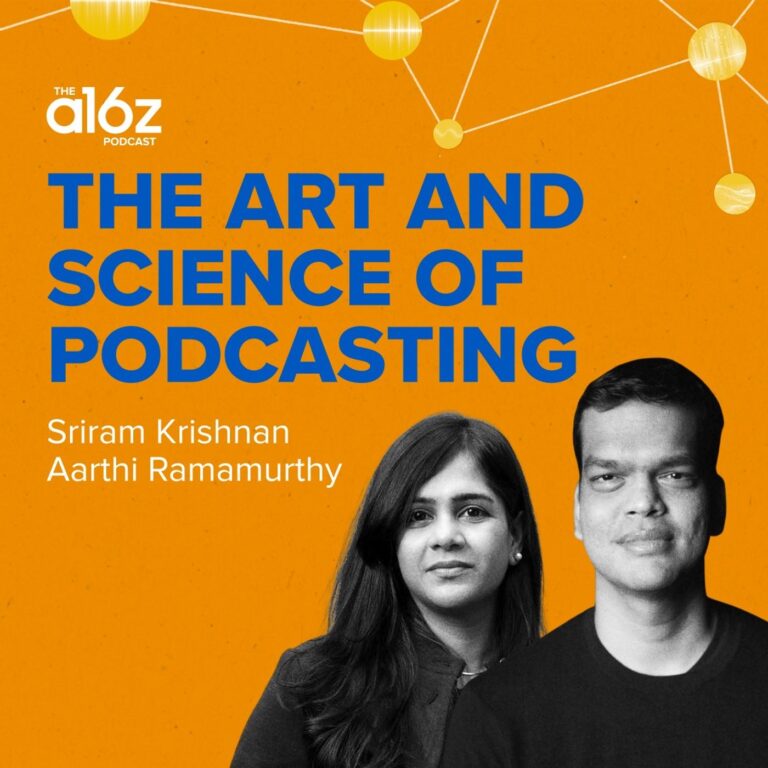
It’s both easier and harder than ever to build a successful podcast. In this episode, we chat with Sriram and Aarthi from the Good Time Show, who ventured into the world of audio peak pandemic and have since interviewed the likes of Elon Musk, Calvin Harris, and Naomi Osaka.
We get their perspective on how to succeed in this competitive landscape, differentiation and the sliding scale of entertainment and information, the difference between an audience and a community, podcast analytics and how they’re changing, and even what Sriram has learned from his frontrow experience at Twitter recently.
Topics Covered:
- 00:00 – Intro
- 02:20 – Podcast trivia
- 06:07 – Starting a podcast
- 08:45 – Differentiating
- 13:10 – Information vs entertainment
- 18:08 – Getting off the talk track
- 20:40 – Growth and metrics
- 22:31 – Authenticity
- 27:10 – Secret sauce of podcasting
- 28:10 – Advice for new podcasters
- 29:58 – In-person events
- 32:06 – Tech as a force for good
- 34:50 – The next wave of social
- 37:23 – Creator middle class
- 41:16 – Podcast infrastructure
- 42:55 – ChatGPT
- 45:10 – Swapping lives with a celebrity
- 52:26 – Your personal monopoly
Resources:
Find Sriram on Twitter: https://twitter.com/sriramk
Find Aarthi on Twitter: https://twitter.com/aarthir
Find Aarthi and Sriram on Youtube: https://www.youtube.com/@AarthiAndSriram
Check out the Good Time Show: https://www.aarthiandsriram.com/
Stay Updated:
Find us on Twitter: https://twitter.com/a16z
Find us on LinkedIn: https://www.linkedin.com/company/a16z
Subscribe on your favorite podcast app: https://a16z.simplecast.com/
Follow our host: https://twitter.com/stephsmithio
Please note that the content here is for informational purposes only; should NOT be taken as legal, business, tax, or investment advice or be used to evaluate any investment or security; and is not directed at any investors or potential investors in any a16z fund. For more details please see a16z.com/disclosures.
Leave a Reply
You must be logged in to post a comment.