

Summary & Insights





The idea that ChatGPT might know you better than Google—or even your closest friends—isn’t just a hypothetical; it’s a reality for some users today, signaling a profound shift in how we relate to technology. This conversation between a16z investors explores the current state of consumer applications in the AI era, moving beyond creative tools like Midjourney to examine how AI is beginning to mediate fundamental human needs like connection, advice, and entertainment. They argue that consumer spending is being reshaped, with software rivaling essentials like food and rent as AI becomes a ubiquitous intermediary in our daily lives.
The discussion grapples with the puzzle of what a true AI-native social network might look like, since past platforms were built on human-generated status updates with real emotional stakes. The next wave may not be a skeuomorphic feed of AI bots, but rather a platform where your deeply personalized AI avatar or essence can connect with others, filling the growing “social white space.” Furthermore, the business models are fundamentally different: companies are generating significant revenue immediately, with users happily paying premium subscriptions ($200/month or more) because AI tools deliver tangible, time-saving value, leading to revenue retention that outpaces user retention.
A significant portion of the talk focuses on the explosive, often misunderstood category of AI companions. The definition has expanded far beyond “AI girlfriends” to include coaches, therapists, niche experts, and even memory companions for the elderly. These tools are stepping in to address a documented decline in close friendships, and early data suggests they can act as a bridge to better human connection, not just a replacement. Finally, the investors re-examine traditional notions of defensibility, concluding that in this early, fast-moving era, velocity—speed in distribution, model iteration, and product launches—is itself the most critical moat.
Surprising Insights
- Enterprise adoption is leading consumer adoption for some AI products. Companies like ElevenLabs found that enterprise customers (e.g., call centers, entertainment studios) signed major contracts shortly after a consumer viral moment, driven by a corporate mandate to implement AI, a pattern not seen in previous tech cycles.
- Revenue retention significantly outpaces user retention. Unlike traditional subscriptions, AI product users frequently upgrade plans, buy credit packs, and incur overages, meaning the revenue from a cohort often grows even if the user count stays flat or slightly declines.
- AI companions are showing early evidence of improving mental health and social skills. Anecdotes and studies (e.g., involving Replika) suggest these tools can reduce anxiety, depression, and suicidal ideation for some users, and can even act as social coaches, helping people practice interaction before engaging in the “3D world.”
- The “velocity” of development and distribution is currently a stronger moat than traditional network effects. In a landscape of rapidly improving models, the ability to ship high-quality updates and capture mindshare quickly is proving more defensible than waiting for a network effect to kick in.
Practical Takeaways
- Consider voice as a primary interface for your product. The technology has finally matured, and voice naturally intermediates huge swaths of human interaction (coaching, support, companionship), representing a major unexplored frontier for AI applications.
- Build for immediate, tangible value to justify premium pricing. Consumers have shown a willingness to pay high monthly fees for AI tools that save them significant time or unlock new capabilities (e.g., deep research, creative video generation). Focus on delivering concrete, work-related or deeply personal utility.
- Prioritize product velocity and model quality over chasing classic network effects early on. In the current phase, quickly iterating and staying at the technology frontier is more crucial for retention and growth than prematurely engineering viral social loops.
- Explore vertical, specific companionship use cases. Instead of building another general-purpose chatbot, consider niche domains where an AI can provide specialized counsel, company, or expertise—from nutrition coaches to historical conversation partners for seniors.
- Design AI interactions with calibrated “disagreeableness.” For companions or coaches to be effective and prepare users for real human relationships, they must avoid being purely agreeable and instead offer constructive feedback and balanced perspectives.
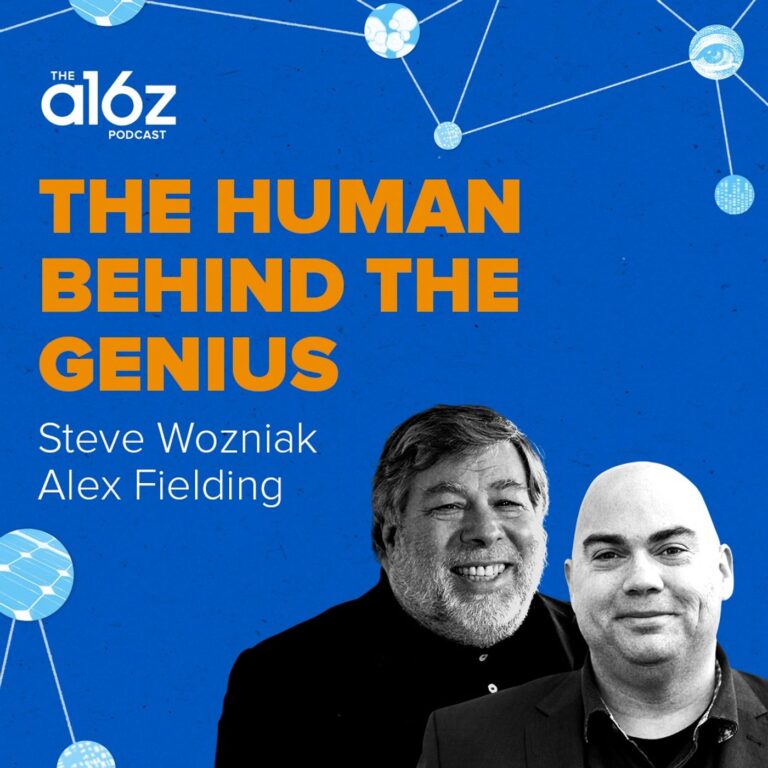
In this special episode, we share never heard before footage from Steve Wozniak alongside his cofounder and best man, Alex Fielding.
Listeners get an inside look into what drove Woz to building a computer, but also how Steve’s zest for life was applied beyond computers – from the rare opportunity to play Tetris on the side of a building or throw a concert across borders.
Full Privateer episode: https://a16z.simplecast.com/episodes/new-the-data-highway-above-with-privateers-steve-wozniak-alex-fielding-and-dr-moriba-jah
Full Privateer episode on Youtube: https://youtu.be/ZZbrwxOs0y4
Stay Updated:
Find us on Twitter: https://twitter.com/a16z
Find us on LinkedIn: https://www.linkedin.com/company/a16z
Subscribe on your favorite podcast app: https://a16z.simplecast.com/
Follow our host: https://twitter.com/stephsmithio
Please note that the content here is for informational purposes only; should NOT be taken as legal, business, tax, or investment advice or be used to evaluate any investment or security; and is not directed at any investors or potential investors in any a16z fund. For more details please see a16z.com/disclosures.
Leave a Reply
You must be logged in to post a comment.