

Summary & Insights





Imagine a world where your computer doesn’t just compute, but actively wants to make you happy—a “really smart puppy” trained to be your creative partner and eager assistant. This is the optimistic core of Marc Andreessen’s vision for AI, presented in a wide-ranging conversation that pushes back against the prevailing narrative of existential threat. He argues that after 80 years of research, the arrival of powerful, general-purpose AI represents a profound breakthrough for human empowerment, not an apocalypse. The discussion spans from the history of AI winters to a future where this technology acts as a universal augmenter, dramatically boosting productivity, creativity, and potentially solving grand societal challenges like aging populations and economic stagnation.
Andreessen dissects the current wave of hysteria, framing it as a familiar pattern of “Baptists and bootleggers”—a coalition of genuine concern and cynical opportunism aimed at regulatory capture. He warns that the real danger isn’t rogue machines, but the creation of a cartel that would stifle innovation, inflate prices, and freeze progress, much like what has happened in industries from defense contracting to higher education. The conversation also tackles practical concerns like “hallucinations” and jailbreaking, not as fatal flaws, but as trillion-dollar engineering challenges that will be solved, leading to systems with sliders ranging from pure creativity to hyper-literalism.
Geopolitically, the dialogue positions AI as the central battleground in a new Cold War, contrasting a Western vision of AI as a tool for individual empowerment with an authoritarian model focused on population control. The ultimate takeaway is a call to action: to ensure this technology develops in an open, competitive, and decentralized manner, society must actively use it, support open-source initiatives, and engage politically to prevent a future where its benefits are locked down by a few entrenched players.
Surprising Insights
- AI as a Creative Partner, Not Just a Calculator: The “hallucination” problem in LLMs is reframed as a foundational breakthrough—the birth of genuine computational creativity. For the first time, computers can be partners in brainstorming, art, and open-ended exploration, domains where purely literal, deterministic systems were useless.
- Demographic Savior: One of the most compelling long-term cases for AI and robotics is as a solution for collapsing birth rates. They could form the “young workforce” in aging societies, providing the economic output needed to support retired populations and maintain social stability.
- The Baptist and Bootlegger Dynamic: The intense backlash against AI is analyzed not as organic panic, but as a classic political pattern. “Baptists” (true believers in the danger) are unwittingly leveraged by “bootleggers” (established interests seeking regulatory capture) to create cartels that crush competition.
- Trickle-Up Technology Adoption: Unlike past innovations (like the mainframe) that started with governments and trickled down, modern AI is being adopted by consumers first, then small businesses, then enterprises, with governments last. This reverses the traditional power dynamic and accelerates individual access.
- Warfare Could Become Safer: Contrary to visions of killer robots, AI-augmented command and control could reduce the “fog of war,” minimize friendly fire, and lead to more precise, less emotionally-driven conflict, potentially making warfare less deadly.
Practical Takeaways
- For Individuals: Actively use and integrate AI tools into your daily work and creative pursuits. The more broadly and deeply the technology is embedded in society, the harder it becomes to restrict or control.
- For Builders and Programmers: Engage with and contribute to the open-source AI ecosystem. Decentralized, widely-available models are a powerful bulwark against the formation of a controlling cartel.
- For Policymakers: Deliberately seek a wide range of perspectives, especially from builders and a broad set of users, not just from doomsayers or large incumbent companies with vested interests in regulatory capture.
- For Citizens in Democracies: Make your voice heard to elected representatives. Advocate for policies that foster a competitive, open-market approach to AI innovation rather than preemptive lockdown.
- Reframe “Correctness”: When applying AI, consider whether the task requires literal correctness (e.g., accounting) or creative generation (e.g., brainstorming). The technology will increasingly offer controls to match the mode you need.
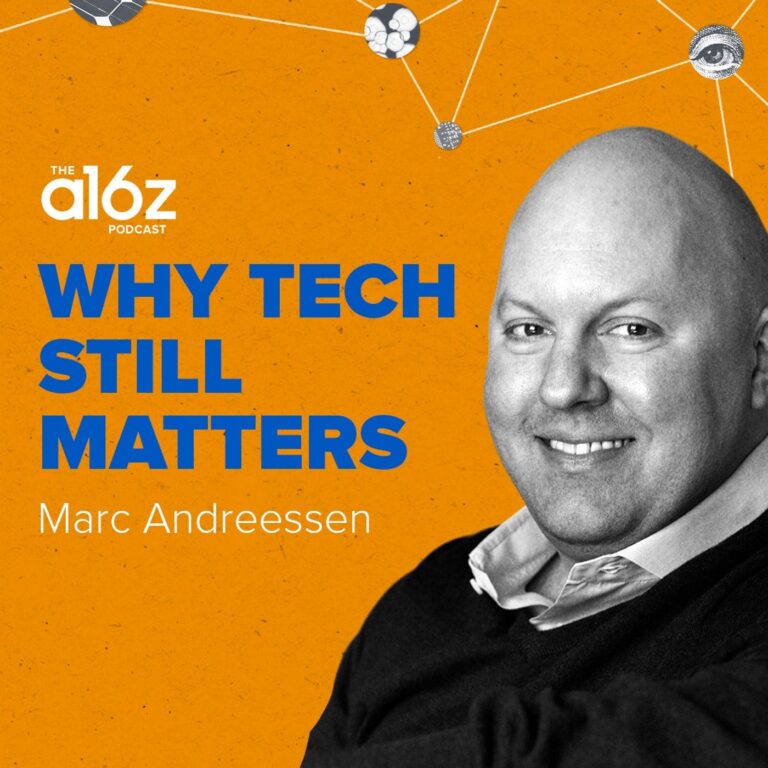
With much coverage of technology lined with pessimism, the a16z Podcast returns to highlight the bright side of technology, alongside the founders building it. But before featuring the solutions in progress, we wanted to explore why building the future is still so important.
And who better to traverse this ground than a16z’s own cofounder Marc Andreessen, who has built and invested in the future time and time again, especially when it wasn’t the obvious thing to do.
Together with Marc, this episode explores technology through the lens of history – including the three stages of human psychology as we encounter new technologies, how that process often manifests in regulation, when to change your mind, the Cambrian explosion of opportunity coming from distributed work, the importance of founder-led companies, and perhaps most importantly, we examine why there’s still much reason for optimism.
Timestamps:
00:00 – Welcome back!
02:19 – The importance of tech today
05:25 – Historical negativity toward technology
9:40 – The invention of the bicycle
13:16 – Innovation vs status in society
20:45 – Automobile moral panic and red flag laws
24:52 – Balaji’s arc on social networking
27:44 – Surfacing signal from noise
34:06 – The role of timing in innovation
37:39 – Today’s major unlocks
44:59 – Remote work and society reshuffling
49:49 – Changing your mind
54:06 – Retaining a lens of optimism
1:04:25 – What Marc’s excited about
1:08:41 – Bourgeois vs managerial capitalism
1:17:32 – Reform vs starting anew
Resources:
Marc on Twitter: https://twitter.com/pmarca
Pessimist’s Archive: https://pessimistsarchive.org/
Stay Updated:
Find us on Twitter: https://twitter.com/a16z
Find us on LinkedIn: https://www.linkedin.com/company/a16z
Subscribe on your favorite podcast app: https://a16z.com/podcasts
Follow our host: https://twitter.com/stephsmithio
Please note that the content here is for informational purposes only; should NOT be taken as legal, business, tax, or investment advice or be used to evaluate any investment or security; and is not directed at any investors or potential investors in any a16z fund. For more details please see a16z.com/disclosures.
Leave a Reply
You must be logged in to post a comment.