

Summary & Insights





The audience is laughing uproariously during the most violent sequence of Once Upon a Time in Hollywood—a bizarre, cathartic reaction that perfectly encapsulates the film’s power to rewrite a national trauma through dark comedy and alternative history. This moment underscores a central thesis explored in the conversation: certain films transcend entertainment to become vital cultural documents, capturing and sometimes reimagining America’s pivotal turning points. Once Upon a Time is dissected as a love letter to a lost Los Angeles and a “what if” scenario where the optimism of the 1960s wasn’t shattered by the Manson murders, serving as a prism to understand the darker path the country actually took.
The discussion expands to other films that function as sharp cultural x-rays. Tropic Thunder is celebrated not just as a hilarious Hollywood satire, but as a time capsule of a pre-woke era where satire could ruthlessly lampoon every sacred cow—from method acting and Oscar bait to the fabrication of war heroism—all while featuring Robert Downey Jr.’s Oscar-nominated performance in blackface. In contrast, Oppenheimer is critiqued for its modern moral framing, which the speakers argue simplifies history to vilify Cold War security concerns and sanctify its scientists, missing a more nuanced truth about how the nuclear deterrent may have prevented larger conflicts. Finally, Fight Club is examined as a film whose political interpretation has completely flipped over decades, from a left-wing anti-capitalist screed in the 1990s to a film that now reads as a right-wing critique of emasculated modernity.
Through these examples, the conversation posits that great films about Hollywood are ultimately films about America itself. They reflect the anxieties, ideals, and identity crises of their moments of creation. Whether offering cathartic revenge fantasies for past cultural wounds, serving as unimpeachable satire that could no longer be made, or revealing how historical narratives are reshaped by present-day morals, these movies provide a unique lens on the nation’s evolving story. The analysis suggests that the most enduring art doesn’t provide easy answers, but instead holds up a mirror—or in Tarantino’s case, a funhouse mirror—to the complex soul of the country.
Surprising Insights
- The Manson murders as a cultural watershed: The conversation posits that the Manson murders, often viewed as a isolated true-crime horror, were in fact the specific event that punctured the utopian bubble of the 1960s counterculture, triggering a national shift toward fear, distrust, and the darker, more cynical 1970s.
- Tropic Thunder as an unrepeatable artifact: The film is highlighted not just for its comedy, but as a stunning example of satire that, made in 2008, managed to expertly skewer Hollywood, war narratives, and identity politics in a way that would be considered entirely off-limits just a few years later during the 2010s cultural revolution.
- The flipped political valence of Fight Club: The analysis notes that Fight Club, widely received as an anti-capitalist, anarchist, left-wing film upon release, now scans for many viewers as an ultra right-wing, almost “incel” manifesto—a stark demonstration of how a film’s message is entirely dependent on the cultural moment viewing it.
- Oppenheimer’s “hero” might be its villain: A counterintuitive reading of Oppenheimer suggests that Lewis Strauss, portrayed as the jealous bureaucrat who brings down the great scientist, was arguably correct in his security concerns, which were validated by historical fact (Soviet espionage), making him a more morally defensible figure than the film presents.
- The strategic marketing as part of the art: The discussion reveals how Tropic Thunder and Once Upon a Time extended their artistic statements into real-world marketing and engagement, from Tropic Thunder’s fake trailers and “Booty Sweat” drinks to Tarantino personally winning over the Tate family, blurring the line between the film and the culture it critiques.
Practical Takeaways
- Use film as a lens for cultural history. When studying a past era, look to its most ambitious films about themselves (like Hollywood movies) to understand the period’s anxieties, hopes, and self-perception.
- Question the moral framing of historical narratives. Be skeptical of modern retellings of history, like Oppenheimer, that may impose today’s political morals onto complex past events, potentially simplifying or inverting the actual ethical dilemmas faced at the time.
- Revisit art from different cultural moments. Watch culturally significant films from 10, 20, or 30 years ago with an eye for how their messages and perceived “sides” have shifted with the times, deepening your understanding of both the art and social change.
- Look for the alternative history in storytelling. Recognize when a narrative, like Once Upon a Time in Hollywood, is offering a “what if” counterfactual; this can powerfully clarify the weight and consequence of what actually happened by showing a vivid road not taken.
- Appreciate satire as a cultural risk. Value audacious satire like Tropic Thunder made in permissive cultural moments, as it can expose hypocrisies and tensions in ways that more cautious eras cannot, serving as an important pressure valve and record.
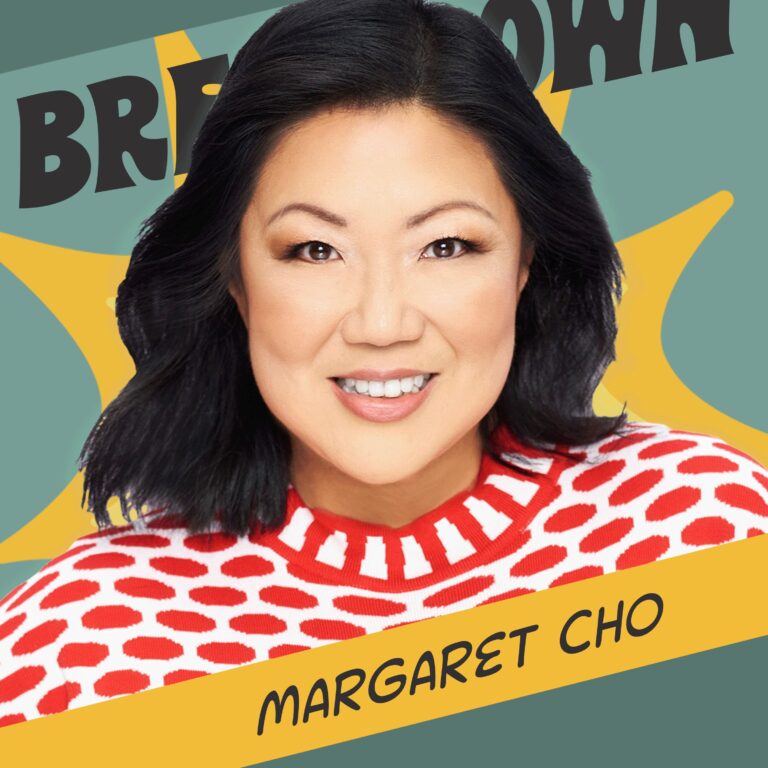
Margaret Cho (comedian, Fire Island, Flight Attendant, Hacks) opens up about dissociation, queerness, and her love for rescuing animals. She gives us a peek into her impressive cat palace, explains what bisexuality means to her and why comedy is her safe space. Margaret discusses the origins and triggers of her struggles with dissociation and how she is able to harness its benefits in her acting. She takes us through her journey through recovery from opiate abuse and her experiences with EMDR therapy. Mayim breaks down compulsive overeating, and she and Margaret consider the notion of palatability within the entertainment industry, especially when it comes to body- and age-shaming.
See Margaret Cho on tour: https://margaretcho.com/tour/
Leave a Reply
You must be logged in to post a comment.